
Natural Selection
E N D
Presentation Transcript
Darwin vs Lamarck • Lamarck - animals pa on acquired traits • Darwin - individuals are selected for survival by combinations of traits • see page 303
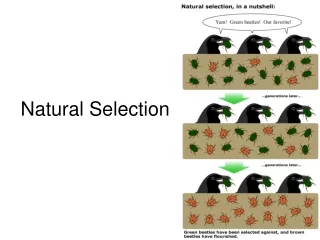
Darwin... • More individuals are born than live to reproduce • individuals vary from one another • individuals compete with each other for resources • individuals with the best combination of traits for the given conditions will survive
Neo-Darwinism or Synthetic theory of evolution • Darwin posited that traits are passed on directly to the next generation • Mendel had already determined that traits are passed along as a matter of chance • the combination of Darwinian natural selection and Mendelian genetics is called the synthetic theory of evolution
Evidence of evolution • Fossil record • Comparative anatomy (see Figure 7-17 on page 308) • Biogeography • subcellular
Comparative anatomy • Homologous features- similar structure in different species • Analogous features - similar function different structure (convergent evolution) • Vestigial organs
Biogeography • Evolution occurs only once • Center of origin • Related species have similar patterns of development (figure 17-12, page 313)
Subcellular • DNA is universal • the longer the time since divergence the greater the difference in DNA
Microevolution • Population = gene pool • Microevolution- small gradual changes within a population over time. Accounts for differences between population of same species
Hardy-Weinberg Principle • This never occurs in nature but helps to understand the forces of evolution. • The frequency of genotypes in a population can be determined /described mathematically • Inheritance itself will not cause a change in allele frequencies
Inheritance itself will not cause a change in allele frequencies • Allele frequencies will not occur if • there is random mating • there are no mutations • there is no migration • there is no natural selection • UNDER THESE CONDITIONS THERE IS GENETIC EQUILIBRIUM!!!!
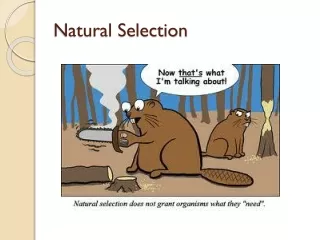
Mutation • A random, permanent change in DNA • does not determine the direction of evolution (mutations occur randomly, not in response to need or conditions) • Genetic drift - (founder effect) • Genetic bottleneck -
Selection • Stabilizing selection - tends to make population more uniform • Directional stabilization - favors one extreme • Disruptive stabilization - favors both extremes • see page 327
Variation • Genetic polymorphism - two or more alleles for a given gene. • What is the heterozygous advantage?
Speciation • Species - members freely breed with one another • Reproductive isolation - • temporal isolation (different times) • behavioral isolation (courtship patterns) • mechanical isolation
Speciation • Allopatric speciation - geographic separation results in new species • sympatric speciation - divergence in same geographic area (insects)