Register Making Machine
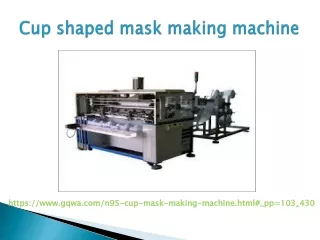
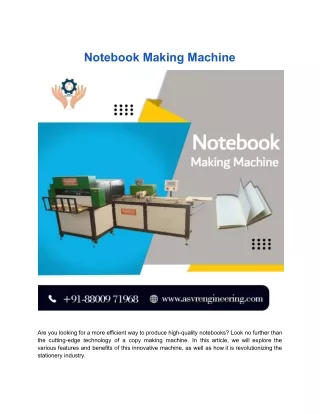
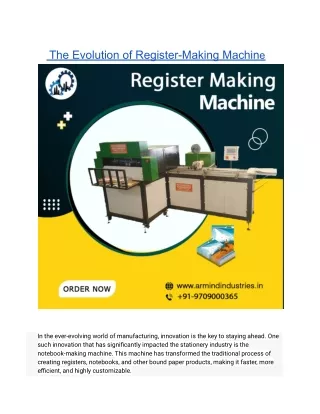
A register making machine is a specialized piece of equipment designed to automate the production of registers, such as notebooks, ledgers, and journals. These machines handle various processes including cutting, folding, stitching, and binding of paper. They can produce registers of different sizes and thicknesses with high precision and efficiency. Modern register making machines often feature digital controls and automation capabilities, allowing for easy adjustments and customization. They are widely used in printing and stationery industries to meet large-scale production demands while en

Register Making Machine
E N D
Presentation Transcript
The Evolution of Register-Making Machine In the ever-evolving world of manufacturing, innovation is the key to staying ahead. One such innovation that has significantly impacted the stationery industry is the notebook-making machine. This machine has transformed the traditional process of creating registers, notebooks, and other bound paper products, making it faster, more efficient, and highly customizable.
The Need for Register-Making Machines copy, notebooks, and journals are essential tools for students, professionals, and businesses. Traditionally, the production of these items involved a labor-intensive process that was both time-consuming and costly. Manual binding, cutting, and assembling not only required significant human effort but also increased the chances of errors and inconsistencies. With the advent of register-making machines, the industry has seen a shift towards automation, reducing the dependency on manual labor and enhancing productivity. These machines offer precise control over the manufacturing process, ensuring high-quality output and the ability to meet the growing demand for stationery products. How Register-Making Machines Work Register-making machines are designed to handle multiple stages of the production process, including cutting, folding, stitching, and binding. Here's a breakdown of how these machines operate: 1. Paper Feeding and Cutting: The process begins with feeding large sheets or rolls of paper into the machine. Advanced machines come equipped with automatic feeders that can handle various paper sizes and weights. The paper is then precisely cut to the required dimensions. Modern machines use laser or rotary cutters to ensure clean and accurate cuts, minimizing waste. 2. Folding and Creasing:
After cutting, the paper sheets are folded into the desired format, such as single sheets for notebooks or multiple folded sheets for notebooks. Creasing mechanisms create fold lines, ensuring that the paper folds evenly and neatly, which is crucial for a professional finish. 3. Stitching and Binding: The folded sheets are then stitched together using different binding techniques, such as saddle stitching, perfect binding, or spiral binding. The choice of binding depends on the type of register being produced. Advanced copy-making machines offer customizable stitching patterns and binding options, allowing manufacturers to produce a wide range of products. 4. Cover Application and Finishing: The final step involves applying covers to the stitched paper. Covers can be plain, printed, or laminated for added durability and aesthetics. The finished product is then trimmed to ensure uniformity and packed for distribution. Benefits of Register-Making Machines 1. Increased Efficiency: Automation significantly speeds up the production process, allowing manufacturers to produce large quantities of copies in a shorter time frame. 2. Consistency and Quality:
Machines ensure uniformity in size, binding, and finishing, resulting in high-quality products that meet industry standards. 3. Cost-Effectiveness: By reducing manual labor and minimizing material waste, register-making machines lower production costs, making it economically viable for manufacturers. 4. Customization: These machines offer flexibility in terms of design, size, and binding options, enabling manufacturers to cater to diverse customer needs and preferences. 5. Reduced Errors: Automated processes reduce the likelihood of human errors, ensuring that each copy produced meets the desired specifications. The Future of Register-Making Machines As technology continues to advance, copy-making machines are expected to become even more sophisticated. Integration with digital printing technologies, smart sensors, and AI-driven quality control systems will further enhance their capabilities. Additionally, the focus on sustainability will drive the development of eco-friendly materials and processes, making the production of stationery products more environmentally responsible. In conclusion, register-making machines have revolutionized the stationery industry, transforming the way notebooks and notebooks are produced. Their ability to combine efficiency, quality, and customization has made them indispensable tools for manufacturers, ensuring that they can meet the ever-growing demand for high-quality
stationery products. As these machines continue to evolve, they will undoubtedly play a crucial role in shaping the future of the industry.