Mastering Elevation Drawings in Architecture
Learn the fundamentals of elevation drawings including six views, exterior vs. interior elevations, and roof plans. Explore how to add landscape details and dimensioning for accurate representation.

Mastering Elevation Drawings in Architecture
E N D
Presentation Transcript
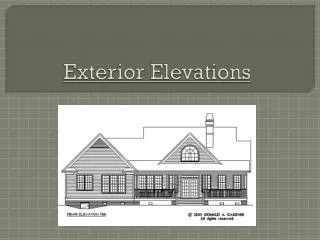
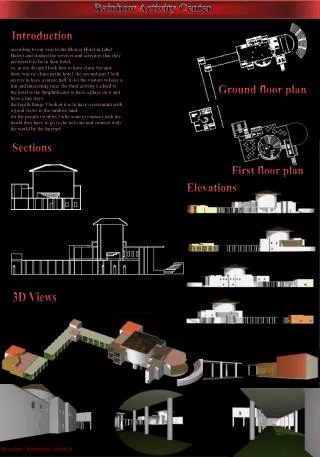
Chapter 16 Drawing Elevations • Multiview projection • Also called orthographic projection • Six views in a multiview drawing • Front elevation • Rear elevation • Left elevation • Right elevation • Roof plan / Top • Bottom view/ basement
Exterior elevations are always drawn to the same scale as the floor plan • A dashed line is used to draw major features below the ground line on an exterior elevation • Presentation Drawing • Elevation drawing to which landscape and material textures have been added • Profile Drawing • Term used to describe the elevation drawing of a site
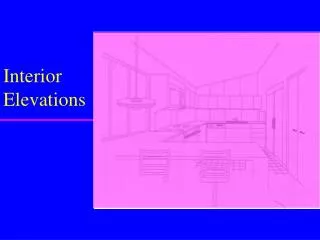
Auxiliary elevation • Drawn when a wall is not at a 90 degree angle on a floor plan • Span • Term used to describe the distance between roof supports • Run • 12 is assigned to the run when calculating roof pitch • Angle of a roof described as a ratio • Double the run to find the span • Interior Elevation • Drawing of an inside wall
Windows and doors • Point of a dashed line represents the part of the window that has the hinge • Numbers or letters are the key to a window or door on a window or door schedule • Should appear on all elevations • Sill • Sash • Mullions • Muntins
Dimensioning • Datum line remains constant on an elevation drawing • Vertical dimensioning should read from right side of a drawing