Understanding Positive and Negative Space in Photographic Depth Perception
This article explores the concepts of positive and negative space in photography and their impact on the perception of depth in two-dimensional artworks. Positive space refers to the areas occupied by the subjects, while negative space encompasses the background. We delve into the roles of foreground, middle ground, and background in creating visual depth, alongside various techniques like linear and atmospheric perspective. By mastering these elements, photographers can manipulate viewer perception and enhance the overall composition of their images.

Understanding Positive and Negative Space in Photographic Depth Perception
E N D
Presentation Transcript
Space The sense of DEPTH in a two-dimensional artwork. Also - The areas taken up by the objects and by the background in a photo.
Positive Space is the area containing the subjects of the photo. Negative Space is the area not occupied by the subjects - usually the background.
Positive & Negative Space Negative Space Positive Space
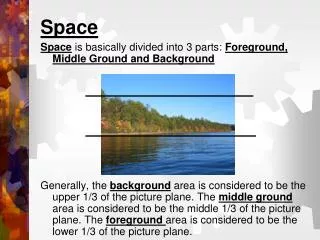
Space can be divided into: • Foreground – the area of the photograph that is closest to the viewer (usually low on the picture plane). • Middle Ground – the area of the photograph between the foreground and the background (usually in the horizontal center of the picture plane). • Background – the area of the photograph that is farthest from the viewer (usually highest on the picture plane).
Background Middle Ground Foreground
Depth of Field Viewpoint The position of the camera (photographer) in relation to a photograph. (Also known as Camera Angle and Vantage Point) . The amount of a photograph that is in focus.
Ways to Create The Illusion of Depthon a 2-Dimensional Surface
Perspective 5. Linear 6. Atmospheric / Aerial
Linear Perspective: A method invented during the Renaissance that creates the illusion of depth on a 2-dimensional surface using a vanishing point on a horizon line where all lines converge. • 1-pt. Perspective • 2-pt. Perspective
1 Point Perspective The method of using a horizon line and one vanishing point to create the illusion of depth on a 2-dimensional artwork.
Vanishing Point Horizon Line
2 Pt. Perspective The method of using a horizon line and 2 vanishing points to create the illusion of depth on a 2-dimensional artwork.
Vanishing Point Vanishing Point Horizon Line
Atmospheric Perspective (Aerial) Distant objects appear blurry and lighter in tone because of the effects of the air between the viewer and the object.