Understanding Diagonals in Parallelograms: Properties of Special Parallelograms
This lesson explores the properties of the diagonals in various types of parallelograms, including rectangles, rhombuses, and squares. Students will investigate whether the diagonals are congruent and if they bisect each other in different parallelogram types. By drawing and measuring the diagonals of special parallelograms, learners will grasp the fundamental theorems that define these shapes: a parallelogram is a rhombus if its diagonals are perpendicular, a rectangle if they are congruent, and a square if they are both.

Understanding Diagonals in Parallelograms: Properties of Special Parallelograms
E N D
Presentation Transcript
6-2C Proofs with Special Parallelograms What happens to the diagonals of parallelograms? What happens to the diagonals of special parallelograms?
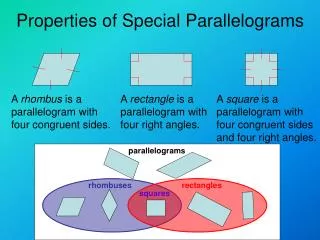
Use the terms parallelogram, rhombuses and rectangles to complete the statements. • Parallelograms, rectangles and rhombuses • Parallelograms • Parallelograms • All squares are ____ • All rhombuses are ____ • All rectangles are ____
Parallelogram • Draw a parallelogram on your paper. • Draw diagonals in your parallelogram. • Measure the diagonals. Are the diagonals congruent? • Do the diagonals bisect each other? Diagonals of a parallelogram bisect each other.
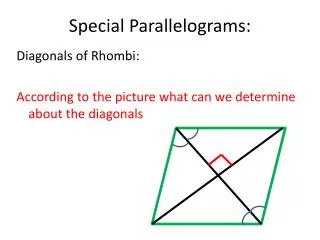
Rhombus • Draw a rhombus on your paper. • Draw diagonals in your rhombus. • Measure the diagonals. Are the diagonals congruent? • Are the diagonals perpendicular? A parallelogram is a rhombus if and only if its diagonals are perpendicular.
Rectangle • Draw a rectangle on your paper. • Draw diagonals in your rectangle. • Measure the diagonals. Are the diagonals congruent? • Are the diagonals perpendicular? A parallelogram is a rectangle if and only if its diagonals are congruent.
Square • Draw a square on your paper. • Draw diagonals in your square. • Measure the diagonals. Are the diagonals congruent? • Are the diagonals perpendicular? A parallelogram is a square if and only if its diagonals are perpendicular and congruent.
Y V X W Classify quadrilateral VWXYusing the given information. • Parallelogram b. Rhombus c. Rectangle d. Square
Find the value of x and y y 5 5 2x −1= x + 2 x = 3 x + 2 = 5 Diagonals bisect each other in a square. 2x − 1 x + 2 Use Pythagorean Theorem to find y. 52 + 52 = y2 25 + 25 = y2 50 = y2 square
Proof If a parallelogram is a rectangle, then its diagonals are congruent. • Reasons • Given • All rect. are parallelogram • Def of rectangle • Def of rt triangle • Opp sides parallel congru • Reflexive • Leg-leg • CPCTC Statements • DEFG is a rectangle • DEFG is a parallelogram 4. ∆DGF and ∆EFG are rt triangles
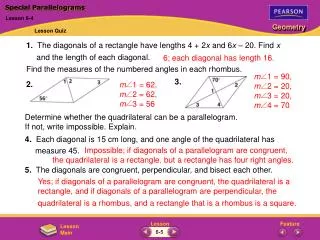
Theorems about Diagonals of Special Parallelograms • A parallelogram is a rhombus if and only if its diagonals are perpendicular. • A parallelogram is a rectangle if and only if its diagonals are congruent. • A parallelogram is a square if and only if its diagonals are both perpendicular and congruent.
What happens to the diagonals of parallelograms? They bisect each other. • What happens to the diagonals of special parallelograms? Rhombus—diagonals are perpendicular Rectangle—diagonals are congruent. Square—diagonals are perpendicular and congruent.
Assignment 6-2C Page 430, 1-15 Copy the chart for 5-12