Understanding Special Parallelograms: Rhombus and Rectangle Properties and Theorems
This guide covers the essential definitions and properties of special parallelograms, specifically rhombuses and rectangles. Key theorems such as how the diagonals behave (e.g., bisecting angles in rhombuses, congruence in rectangles) are highlighted. Examples and exercises illustrate how to apply these properties in problem-solving. Detailed explanations enhance understanding of how builders utilize diagonal properties in construction and design. Homework assignments provide practice to solidify concepts learned.


Understanding Special Parallelograms: Rhombus and Rectangle Properties and Theorems
E N D
Presentation Transcript
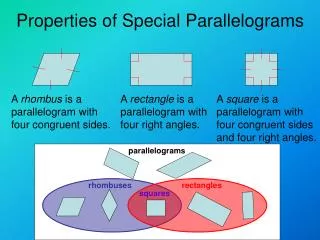
Definitions • Rhombus – a parallelogram with four congruent sides. • Rectangle – a parallelogram with four right angles.
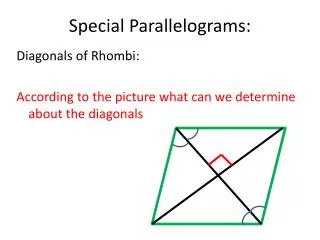
Rhombuses Results • Theorem 6-9: Each diagonal of a rhombus bisects two angles of the rhombus. • Theorem 6-10: The diagonals of a rhombus are perpendicular.
Rectangles Results • Theorem 6.11: The diagonals of a rectangle are congruent.
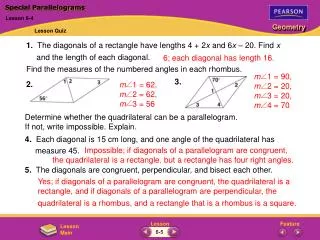
Example 1 • Find the measures of the numbered angles in the rhombus. 1 2 78° 2 3 4
Example 2 • One diagonal of a rectangle has length 8x + 2. The other diagonal has length 5x + 11. Find the length of each diagonal.
Homework • Page 315 # 1-15
Rhombus or Rectangle? • Theorem 6.12: If one diagonal of a parallelogram bisects two angles of the parallelogram, then the parallelogram is a rhombus. • Theorem 6.13: If the diagonals of a parallelogram are perpendicular, then the parallelogram is a rhombus. • Theorem 6.14: If the diagonals of a parallelogram are congruent, then the parallelogram is a rectangle.
Example 1 • A diagonal of a parallelogram bisects two angles of the parallelogram. Is it possible for the parallelogram to have sides of lengths 5, 6, 5, and 6? Explain.
Example 2 • The diagonals of ABCD are perpendicular. AB = 16 cm and BC = 8 cm. Can ABCD be a parallelogram? Explain.
Example 3 • Builders use properties of diagonals to “square up” rectangular shapes like building frames and playing field boundaries. • How could you use diagonals to locate the four corners of a rectangular patio? • How could you use diagonals to locate the four corners of a square patio? • How could you use diagonals to locate the for corners of a patio shaped like a rhombus?
Homework • Page 315 # 16-21, 45-53