Understanding Special Parallelograms: Rhombuses, Rectangles, and Squares
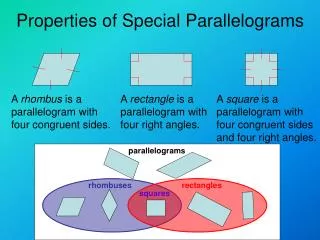
Dive into the properties and theorems of special parallelograms including rhombuses, rectangles, and squares. Learn how to determine if a parallelogram is a rhombus or a rectangle based on diagonal properties. Explore important characteristics such as opposite sides being parallel and congruent, congruent opposite angles, and the unique properties of rhombuses and rectangles regarding their diagonals. Engage with examples and problems to strengthen your understanding of these geometric figures and their relationships.

Understanding Special Parallelograms: Rhombuses, Rectangles, and Squares
E N D
Presentation Transcript
6.4:Special Parallelograms Objectives: To use the properties of diagonals of rhombuses and rectangles Determine whether a parallelogram is a rhombus or a rectangle
Review of the Properties of a parallelogram: • 2 pairs of opposite parallel sides • 2 pairs of opposite congruent sides • Opposite angles are congruent • Consecutive angles are supplementary • Diagonals bisect each other Special Parallelograms: Rhombus, Rectangle, Square • These figures will inherit ALL the properties above, AND they will each add their own individual properties
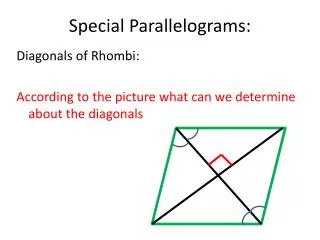
Theorems For a Rhombus: • Each diagonal of a rhombus bisects 2 angles of the rhombus • The diagonals of a rhombus are perpendicular bisects & bisects & D C B A
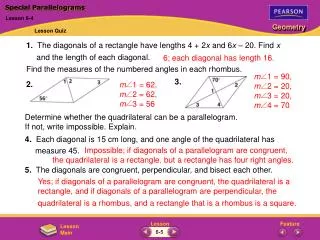
Examples: Find the measures of the numbered angles in the rhombus. 1 12° 2 4 3
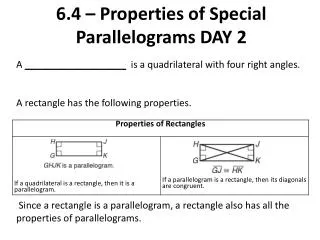
Theorem for Rectangle The diagonals of a rectangle are congruent. (remember, they also are bisected, so all 4 segments created by the intersection are congruent) AND E
EXAMPLE BD=5y-7 and AC = y + 5. Find the value of y and the length of BE. E
THEOREMS If one diagonal of a bisects 2 angles of the then the is a RHOMBUS. If the diagonals of a are perpendicular, then the is a RHOMBUS. If the diagonals of a are congruent, then the is aRECTANGLE.
SQUARE Remember, a square is a RECTANGLE and a RHOMBUS, so it inherits ALL the properties of a rectangle, rhombus and parallelogram.
Determine whether the quadrilateral can be a parallelogram. If not, write impossible. Explain your answer. • Each diagonal is 15 cm long, and one angle of the quadrilateral has a measure of 45°. • The diagonals are congruent, perpendicular, and they bisect each other.