Understanding Probability Rules: Mathematical Notation and Applications
This guide explores the fundamental rules of probability using mathematical notation. It covers key principles such as the range of probabilities (0 ≤ P(A) ≤ 1), the probability of the sample space (P(S) = 1), and the relationship between disjoint and independent events. Additionally, it explains the addition rule for disjoint events and the implications when events overlap. Practical examples, like card drawing scenarios and partner promotions, illustrate how to calculate probabilities using these rules. Perfect for students and anyone looking to deepen their understanding of probability theory.

Understanding Probability Rules: Mathematical Notation and Applications
E N D
Presentation Transcript
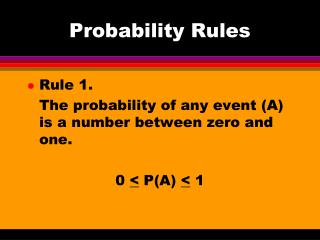
Mathematical Notation for Probability Rules If A = some event, then 0 ≤ P(A) ≤ 1 If S = sample space, then P(S) = 1 P(Ac) = 1 - P(A) If A and B are disjoint: P(A or B) = P(A)+P(B) If A and B are independent: P(A and B) = P(A)P(B)
Union of any collection of events is the event that at least one of the collections occurs. “OR” Example: Suppose S = {deck of 52 cards} and A = {spades} and B = {hearts}. Then A U B (read: A union B ) or (read: A or B) = {spades, hearts}. So drawing any spade or drawing any heart is a member of A U B.
Disjoint events S B A
Addition Rule for Disjoint Events If events A, B, C,..., Z are disjoint, then P(A or B or ... Z) = P(A) + P(B) + ... + P(Z) Example: Using our first card example above, find P(A U B). Solution: A U B = {spades, hearts} = 26 possibilities. P(A or B) = 13/52 + 13/52 = 26/52 = 1/2. Remember: P(A or B) = P(A U B).
But what if our events aren’t disjoint Notice that if we did P(A) + P(B) this time, we’d be counting the intersection of A and B twice! So our formula logically changes to…
FOR ANY EVENTS A and B Note: This formula works for disjoint events as well since for disjoint events is zero! (Draw the Venn Diagram)
Tesia and Courtney are anxiously awaiting word on whether they have been made partners in a law firm. Tesia’s probability of success is 0.7 and Courtney thinks hers is 0.5. The probability they are both promoted is 0.3. Find: a. Probability at least 1 person is promoted? b. Probability that Tesia is promoted and Courtney isn’t? c. Vice versa of part b.
The multiplication rule gets messy when we talk about more than two events. Suppose I wanted the P(A and B and C). P(A)P(B|A)P(C|A and B) A tree diagram is helpful.
6.63 (tree) 6.64 (tree)