Electromagnetic Radiation
Electromagnetic Radiation. Electromagnetic Radiation. Light Quantized energy Quantum theory and the atom. Light. Electromagnetic radiation. Light. Wave nature of light Electromagnetic spectrum Equations. Wave Nature of Light.

Electromagnetic Radiation
E N D
Presentation Transcript
Electromagnetic Radiation • Light • Quantized energy • Quantum theory and the atom
Light Electromagnetic radiation
Light • Wave nature of light • Electromagnetic spectrum • Equations
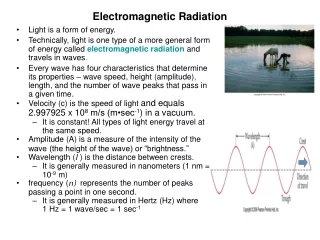
Wave Nature of Light • All light is composed of an electric component and a magnetic component; thus the term electromagnetic radiation
Wave Nature of Light • There are a few terms that we use to characterize light waves • Wavelength (l) • Units are meters (m) • Frequency (n) • Units are Hertz (Hz = seconds -1) • Amplitude
Wave Nature of Light • There are a few terms that we use to characterize light waves
Wave Nature of Light • Although light waves can have different wavelengths and frequencies, they all travel at the same speed; the speed of light 3.0 x 10⁸ m/s
Electromagnetic Spectrum • Remember when we learned about radiation energy we looked at the electromagnetic spectrum • Now we will apply the ideas of wavelength and frequency to the electromagnetic spectrum
Electromagnetic Spectrum • Visible light
Electromagnetic Spectrum • The frequency and wavelength of light are indirectly proportional • As one increases, the other decreases
Equations • The frequency and wavelength of light are indirectly proportional • When frequency and wavelength are multiplied together, they always equal the speed of light Speed of light (c) c = l n
Equations • If we know either the wavelength or the frequency of light, we can calculate the other one by rearranging the equation Ex: If we know the wavelength, n= c/l If we know the frequency, l = c/n
Quantized Energy • Particle nature of light • Emission and absorption spectra
Particle Nature of Light • Certain observations about light interacting with matter were not able to be described by the wave properties of light • Heated objects emit light at specific frequencies at a given temperature • When light of a certain frequency is shined on some metals, electrons are emitted
Particle Nature of Light • Max Planck, a German physicist, discovered that matter can only gain or lose energy in small specific amounts called quanta • A quantum is the minimum amount of energy that can be gained or lost by an atom
Particle Nature of Light • The energy (E) that is emitted by hot objects is related to the frequency (n) of the emitted radiation. • They are related by a number called Planck’s constant (h) • h = 6.626 e-34 J xs E = h n
Particle Nature of Light • h = 6.626 e-34 J x s • Energy is always released in multiples of h n (1 h n, 2 h n, 3 h n,............) E = h n
Particle Nature of Light • When light of a certain frequency is shined on a metal surface, electrons are ejected from the metal. • This phenomenon is known as the photoelectric effect
Particle Nature of Light • Photoelectric effect • Packets of light energy called photons • Energy of light is transferred to the electron increasing the electron’s kinetic energy
Particle Nature of Light • Photoelectric effect
Particle Nature of Light • Atomic emission spectra
Particle Nature of Light • Atomic emission spectra • Electricity passing through the neon gas in the glass tube • Neon atoms absorb that energy and become “excited” • The “excited” atoms release energy as light as they return back to their “ground” state • The atomic emission spectra for an element is the set of frequencies of the light emitted by the atoms as they return to their “ground” state
Particle Nature of Light • Atomic emission spectra • If the light emitted by an element is passed through a prism, the frequencies of the emitted light can be determined
Particle Nature of Light • Atomic emission spectra
Particle Nature of Light • Atomic emission spectra Atomic emission spectra Continuous emission spectra
Particle Nature of Light • Atomic emission spectra • Each element has its own unique emission spectra
Particle Nature of Light • Absorption spectra
Particle Nature of Light • Continuous vs. emission vs. absorption “Excited” gas “Ground state” gas
Particle Nature of Light • We don’t see the colors that are absorbed, only those that are reflected
Particle Nature of Light • We don’t see the colors that are absorbed, only those that are reflected
Particle Nature of Light • Why do you think this pattern occurs?
Quantum Theory and the Atom • Bohr’s model of the atom • Electrons as waves • Heisenberg uncertainty principle
Quantum Theory and the Atom • Bohr used Planck’s idea of quantized energy and applied it to the atom • He proposed that electrons orbit nuclei only at specific distances from the nucleus
Quantum Theory and the Atom • Bohr atomic model
Quantum Theory and the Atom • Bohr atomic model • The orbital closest to the nucleus corresponds to the ground state • The orbitals further away from the nucleus are excited states
Quantum Theory and the Atom • Energy associated with electron orbital transitions
Quantum Theory and the Atom • Energy associated with electron orbital transitions • DE = Ef – Ei • If E is absorbed, Ef> Ei DE is positive • If E is emitted, Ef< Ei DE is negative
Quantum Theory and the Atom • Energy absorbed or emitted can be in frequencies other than just visible light
Quantum Theory and the Atom • De Broglie proposed that electrons moving around the nucleus had wave-like behavior. • The wavelength associated with an electron depends on the mass and velocity of the electron l = h / m v
Quantum Theory and the Atom • The idea of particle – wave duality applies to all matter, not just light and electrons • The mass of objects we can see are so large and the wavelengths are so small that we cannot see this effect l = h / m v
Quantum Theory and the Atom • Heisenberg uncertainty principle (for atomic scale particles) It is impossible to know both the position and the velocity of a particle at the same time
Quantum Theory and the Atom • Anything we do to determine the location or velocity of an electron moves it from its original location and changes its velocity • We can know one or the other but not both • We talk about the probability for an electron to occupy a certain region around the nucleus (so the fixed orbital proposed in the Bohr model are impossible)