Understanding Proportions and Rates: Solving Real-Life Problems
This guide explores the concept of proportions, emphasizing how two ratios can be equivalent. Using relatable examples, such as calculating transportation rates and determining votes in an election, we illustrate the practical applications of proportions. The text covers mental math techniques for solving unknown values in ratios and demonstrates the use of cross products to validate proportions. Engage with real-life scenarios to reinforce your understanding of this essential mathematical concept, making problem-solving intuitive and accessible.

Understanding Proportions and Rates: Solving Real-Life Problems
E N D
Presentation Transcript
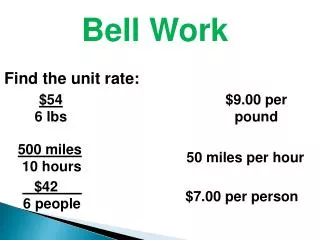
Bell Work Find the unit rate: $54 6 lbs $9.00 per pound 500 miles 10 hours 50 miles per hour $42___ 6 people $7.00 per person
Proportions A proportion is an equation that states that two ratios are equivalent. Example: 2 12 3 18 = = 5 15 9 27
If one of the numbers in a proportion is unknown, mental math can be used to find an equivalent ratio. Example 1: = 2 6 3 x x 3 = 2 6 3 x Hint: To find the value of x, multiply 3 by 3 also. = 2 6 3 9 x 3
If one of the numbers in a proportion is unknown, mental math can be used to find an equivalent ratio. Example : = 28 7 32 x ÷ 4 = Hint: To find the value of x, divide 32 by 4 also. 28 7 32 x = 28 7 328 ÷ 4
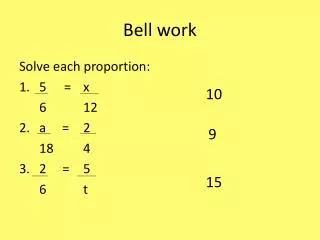
Solve the proportion using equivalent ratios? 4 20 20 10 16
In a proportion, the cross products are equal. = 530 2 12 They are a proportion because they equal the same number
Proportion is a statement that says two ratios are equal. • In an election, Damon got three votes for each two votes that Shannon got. Damon got 72 votes. How many votes did Shannon get? • Damon Shannon n = 48, so Shannon got 48 votes.
Proportion • Tires cost two for $75. How much will four tires cost? • # of tirescost n = 150, so four tires cost $150