Enhancing Scouting Through STEM: A Vision for Future Leaders
The STEM initiative emphasizes the vital role of science, technology, engineering, and mathematics in shaping our economy and future workforce. With only 4% of the nation’s workforce in STEM fields, fostering interest in these areas is crucial for creating jobs and driving economic growth. The integration of Scouting and STEM aims to develop leadership skills, encourage lifelong learning, and engage communities in sustainable practices. Every Scout will earn a STEM Merit Badge, ensuring a generation equipped with the necessary skills and knowledge to thrive in a complex world.

Enhancing Scouting Through STEM: A Vision for Future Leaders
E N D
Presentation Transcript
National Drive for STEM Initiative “The primary driver of the future economy will be largely derived from advances in science and engineering . . . 4% of the nation’s workforce is composed of scientists and engineers who creates jobs for the other 96%.” – Rising Above the Gathering Storm, Revisited, 2010 Economic Prosperity & National Security
Relevance to Scouting: Sustainability Science Natural Systems Science & Technology Local/Global Policy Social Systems
Why STEM and Scouting? • Shared philosophies between Scouting and STEM • Develop leadership skills for the 21st century • Strengthen principles of scouting in the 21st century • Parents’ desire and concern for children’s education
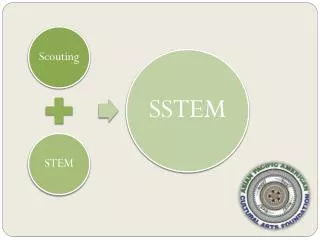
Vision of SSTEM • Every Boy & Girl scout will have STEM Merit Badge • Every family will have at least one child majored in a STEM-related field of study • Scouting Center for STEM everywhere
Mission of SSTEM • Enhance leadership effectiveness with STEM-based knowledge • Integrate public service with STEM practices • Value nature and environment through STEM learning • Excel in STEM subjects and attain higher education in STEM-related fields STEM STEM
Shared Philosophies Between Scouting & STEM • Ethics and integrity • Life-long learning • Humanity and technology • Spirit of collaboration • Leadership with informed decision • Symbiosis of nature and science • Community involvement and influence
STEMPractices Help Scouting • Asking questions and defining problems • Developing and using models • Planning and carrying out investigations • Analyzing and interpreting data • Using mathematics and computational thinking • Constructing explanations and designing solutions • Engaging in argument from evidence • Evaluating and communicating information Practices in K-12 STEM Education
21st Century Skills Help Scouting Source: Education for Life and Work, NAP 2012
Q: Conversely, what can scouting offer for STEM education?A: Provide base support in education and careers for the Vietnamese-American community.Q: Why!? A: There is a need but no one does it yet at the community level.
Education in Our Community Source: A Community of Contrasts – Asian Americans in the United States: 2011 Can Our Community do Better?
Education in Our Community Educational Attainment (25 Years or Older), 2006-2008 Source: The Relevance of Asian Americans & Pacific Islanders in the College Completion Agenda, 2011
SSTEM Focus: Outside the Classroom • Supplementary Classroom Enrichment - Build on goals for classroom STEM study (field trips, demonstrations, after-school science programs) • Sustained Student Learning Communities - Work directly with K–12 students in after-school, weekend, or summer programs to grow skills, knowledge, and potential career pathways • Create opportunities for inspiration outside the classroom • Diversify pathways to STEM careers
SSTEM – Scouting and STEM Formulate Inspire, Engage, Excel
SSTEM – Scouting and STEM Inspire, Engage, Excel
Example: Public Awareness • Help parents & students informed of: • Finance & cost of higher education • Application to college & universities • Emerging STEM-related disciplines • Learning resources (MOOC, open digital textbooks) • Education policy • Internship/Apprenticeship opportunities
Example: Project-based Learning Computing & Simulation Securing Cyberspace Robot Path Planning Digital Humanities Bioinformatics
Example: Game for Learning (6 – 12) • Inspire, engage students and scouts early on • Children think like scientists!
Example: Peer Mentoring • Learning through mentoring: advanced scouts help younger scouts • Offering guidance (directly or indirectly) to students on college or career paths • Inspiring elementary and middle-school students in STEM-related subjects • Providing tutoring service (onsite & online) when possible
Where Do We Get Ideas from? • STEM Experts, Educators, Scout Leaders, Parents, Scouts • Board on Science Education, National Academies, National Science Foundation, Public-private Consortia, Nonprofits
Where Do We Get Ideas from? • National Professional Societies: AAAS, IEEE, ACM, SIAM, …
SSTEM – Challenges • We need to build up infrastructure • Physical location • Volunteer & staff: educators, Scout leaders, STEM experts, parents • We need to establish partnership • With business, industry, national labs, professional societies, nonprofits, local/national government entities • Among participating scout troops
Summary – Main Themes Reasons for Nationwide STEM Initiative
Summary – Main Themes • SSTEM prepares scouting for the 21st century in the light of today’s complex and rapidly evolving world • SSTEM benefits individual scouts by enriching knowledge, skills, civic engagement (STEM is a national agenda) • SSTEM provides out-of-school educational activities to our community.