
Revisiting Neighborhood Inverse Consistency on Binary Constraint Satisfaction Problems
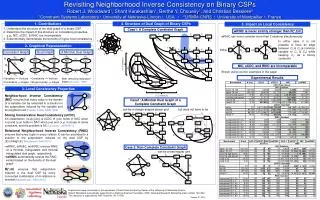
This paper explores the structure of the dual graph of binary Constraint Satisfaction Problems (CSPs) and its impact on various consistency properties, notably Neighborhood Inverse Consistency (NIC), Strong Conservative Dual Consistency (sCDC), and Relational Neighborhood Inverse Consistency (RNIC). Through theoretical insights and experimental validation, we reveal that these consistency properties are incomparable. Additionally, the study demonstrates the benefits of higher-level consistency in addressing local constraints within CSPs, while providing clear graphical representations of these concepts.

Revisiting Neighborhood Inverse Consistency on Binary Constraint Satisfaction Problems
E N D
Presentation Transcript
Revisiting Neighborhood Inverse Consistency on Binary CSPs Robert J. Woodward1, ShantKarakashian1, Berthe Y. Choueiry1, and Christian Bessiere2 1Constraint Systems Laboratory • University of Nebraska-Lincoln • USA • 2LIRMM-CNRS • University of Montpellier • France R4 A B R3 R1 V5 V5 D C Vn Vn Vn C1,5 C3,5 C2,5 R2 C1,n Cn-1,n C3,n C2,n V1 V3 V1 Vn-1 V3 V2 V1 V4 C1,2 C1,5 C1,4 C1,4 C3,4 V2 C2,5 R2 R1 R1 R2 V1 V5 V4 V3 V2 V2 V5 R1 R1 R2 R2 V3 V1 V5 V5 V5 D D C1,5 C4,5 C3,5 C2,5 C3,5 AD AD CD CD C1,2 C1,3 C1,4 C1,5 C2,3 V1 Ci,n C2,3 V1 V4 V3 V2 A A C C A V2 V5 V2 V3 V4 V4 V4 Vi C2,5 C3,4 AB AB AC AC C2,4 C3,5 C1,4 C3,4 C2,4 A A Ci,n-1 C1,2 (n-i) vertices R4 R4 R4 R4 R3 R3 R3 R3 C2,3 C4,5 V3 V2 V1 Vi C1 • 1. Contributions • 4. Structure of Dual Graph of Binary CSPs V3 • 5. Impact on Local Consistency V1 C1 V3 V4 Vi Vi C3,4 C1,3 C2,3 V1 V2 V1 V1 Ci,i+1 C2 C4 V1 V2 V1 C2 C4 V2 V3 • Understand the structure of the dual graph of a binary CSP • Determine the impact of this structure on consistency properties, e.g., NIC, sCDC, & RNIC are incomparable • Experimentally demonstrate the benefits of higher-level consistency Vi V5 V5 V5 V3 C1,2 Case1: A Complete Constraint Graph C4,5 C1,5 C3,5 C2,5 C3 C3 C1,i Ci-2,i C3,i C2,i wRNIC is never strictly stronger than R(*,3)C Vi Vi Vi V1 V4 V3 V2 V4 V4 C1,4 C3,4 C2,4 V3 Vi V3 V2 V1 wRNIC can never consider more than 3 relations simultaneously V2 Vn-1 (i-2)vertices V3 C2,3 C1,3 V1 Vn V2 V1 In either case, it is not possible to have an edge between C3 & C4 (a common variable to C3 & C4) while keeping C3 as a binary constraint C1,2 • 2. Graphical Representation Either or • Constraint Graph • Dual Graph • A Minimal Dual Graph NIC, sCDC, and RNIC are incomparable Shown using counter-examples in the paper Experimental Results • Variables ⟿ Vertices • Constraints ⟿ Edges • Constraints ⟿ Vertices • Scope overlap ⟿ Edges After removing redundant edges[Janssen+, 1989] • 3. Local Consistency Properties A C Neighborhood Inverse Consistency (NIC) ensures that every value in the domain of a variable can be extended to a solution in the subproblem induced by the variable and its neighborhood [Freuder & Elfe, AAAI 1996] Case1: A Minimal Dual Graph of a Complete Constraint Graph B D … can be a triangle-shaped planar grid … but does not have to be V2 Strong Conservative Dual Consistency (sCDC) An instantiation {(x,a),(y,b)} is sCDCiff (y,b) holds in SAC when x=a and (x,a) holds in SAC when y=b and (x,y) in scope of some constraint, and the problem is AC [Lecoutre+, JAIR 2011] V5 C4,5 C2,5 V5 V4 V2 C1,2 C1,5 C2,4 V2 V1 V5 V4 V1 V3 Relational Neighborhood Inverse Consistency (RNIC) ensures that every tuple in every relation Ri can be extended to a solution in the subproblem induced on the dual CSP by {Rj}∪Neigh(Ri) [Woodward+,AAAI 2011] C1,3 C3,4 C2,3 V3 V3 V4 V1 C1,4 C3,5 • wRNIC, triRNIC, wtriRNIC enforce RNIC on a minimal, triangulated, and minimal triangulated dual graph, respectively • selRNIC automatically selects the RNIC variant based on the density of the dual graph Case 2: Non-Complete Constraint Graph … can be a less regular grid R(*,m) ensures that subproblem induced in the dual CSP by every connected combination of m relations is minimal[Karakashian+, AAAI 2010] Experiments were conducted on the equipment of the Holland Computing Center at the University of Nebraska-Lincoln. Robert Woodward was partially supported by a National Science Foundation (NSF) Graduate Research Fellowship grant number 1041000. This research is supported by NSF Grant No. RI-111795. October 3rd, 2012
