The Sonnet
This exploration delves into the rich tradition of sonnets, highlighting Petrarch's impact on both Italian and English poetry. The sonnet form, characterized by the rhyme scheme abba abba cde cde (Italian) and variations such as abab cdcd efef gg (English), encapsulates themes of unrequited love, unattainable beauty, and idolatry. Key figures such as Sidney, Spenser, and Shakespeare expand on Petrarchan conventions, illustrating sentiments of love, beauty, and the inevitability of time's passing. The use of oxymorons and the portrayal of love's suffering are central to understanding this poetic legacy.

The Sonnet
E N D
Presentation Transcript
The Sonnet Italian and English
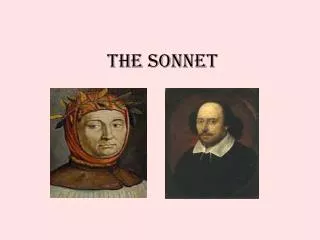
Petrarch (Italian) • 1304-1374 • Pet-rark • Rhyme Scheme: abba abba cde cde • Iambic Pentameter • Sonnet Cycles (sequences) • Laura
Italian Sonnet • Love at first sight • Unattainability of the object of love; unrequited love • Lady as ideally beautiful • Love as idolatry • Use of oxymorons to describe the suffering of the lover
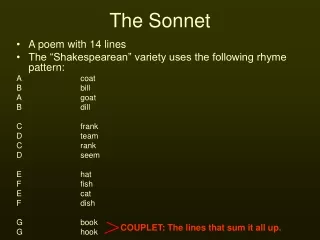
English Sonnet • Change in rhyme scheme: abab cdcd efef gg – abab bcbc cdcd ee • Sonnet cycle tradition continues • Important sonneteers: Sidney, Spenser, Shakespeare • Subject matter: Petrarchan conventions Spenser – wife, Shakespeare – Fair young man, Dark lady, realistic attitude towards beauty and love
Sonnet 12 • When I do count the clock that tells the time, And see the brave day sunk in hideous night; When I behold the violet past prime, And sable curls all silver'd o'er with white;When lofty trees I see barren of leaves Which erst from heat did canopy the herd,And summer's green all girded up in sheaves Borne on the bier with white and bristly beard, Then of thy beauty do I question make, That thou among the wastes of time must go,Since sweets and beauties do themselves forsakeAnd die as fast as they see others grow; And nothing 'gainst Time's scythe can make defence Save breed, to brave him when he takes thee hence.