Understanding Striated and Involuntary Tissue Types in Human Anatomy
160 likes | 292 Vues
This exercise focuses on identifying specific types of tissues in human anatomy. Striated and involuntary tissue, such as cardiac muscle, has unique characteristics that differentiate it from other tissue types. Additionally, we explore connective tissues that contain fibroblast cells and various fibers. Key connective tissues include hyaline cartilage, dense regular and irregular tissues, elastic cartilage, and adipose tissues. This practice reinforces knowledge of muscle tissues such as smooth, cardiac, and skeletal muscle, as well as neurons and osseous tissue.


Understanding Striated and Involuntary Tissue Types in Human Anatomy
E N D
Presentation Transcript
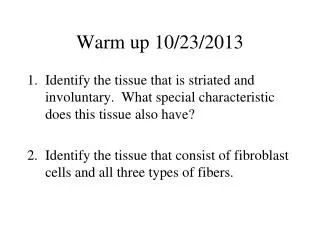
Warm up 10/23/2013 • Identify the tissue that is striated and involuntary. What special characteristic does this tissue also have? • Identify the tissue that consist of fibroblast cells and all three types of fibers.
CT, MT, NT, Glands Practice…