Water Inside Mars
This study investigates the differences in water content present in the mantle sources of enriched and depleted shergottites, using apatite from the Shergotty and QUE 94201 meteorites as primary samples. By measuring OH contents, we aim to correlate water concentration with other geochemical parameters. Our findings suggest a striking contrast: enriched shergottites (Shergotty) have higher water content (0.46–0.86 wt%) compared to depleted ones (QUE 94201: 0.22–0.64 wt%), highlighting the influence of water in their formation and oxidation states.

Water Inside Mars
E N D
Presentation Transcript
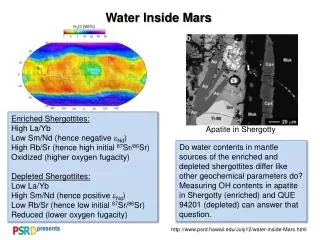
Water Inside Mars Enriched Shergottites: High La/Yb Low Sm/Nd (hence negative Nd) High Rb/Sr (hence high initial 87Sr/86Sr) Oxidized (higher oxygen fugacity) Depleted Shergottites: Low La/Yb High Sm/Nd (hence positive Nd) Low Rb/Sr (hence low initial 87Sr/86Sr) Reduced (lower oxygen fugacity) Apatite in Shergotty Do water contents in mantle sources of the enriched and depleted shergottites differ like other geochemical parameters do? Measuring OH contents in apatite in Shergotty (enriched) and QUE 94201 (depleted) can answer that question.
Water Inside Mars Apatite: Ca5(PO4)3(F,Cl,OH) H2O Measurements: Shergotty: 0.46 to 0.86 wt% QUE 94201: 0.22 to 0.64 wt% H2O in magma when apatite crystallizes: Shergotty: 1.5 to 2.8 wt% QUE 94201: 0.7 to 2.1 wt% (McCubbin et al., 2012) H2O in pre-eruptive magma (assumes apatite crystallizes when 10% of melt remains): Shergotty: 0.15 to 0.29 wt% QUE 94201: 0.07 to 0.21 wt%