Download
1 / 16
160 likes | 277 Vues
This study explores the application of the Soil and Water Assessment Tool (SWAT) to model pesticide fate in a Luxembourgish catchment, with a focus on validating model predictions using passive samplers (POCIS). The research highlights challenges in calibrating pesticide emission models, including unknown application dates, amounts, and compound properties. Insights from passive sampler data may enhance our understanding of pesticide emissions' spatiotemporal dynamics. The findings aim to improve environmental monitoring and policy implementation for water quality management under the EU's Water Framework Directive.

E N D
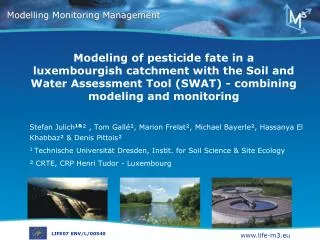
Modeling of pesticide fate in a luxembourgish catchment with the Soil and Water Assessment Tool (SWAT) – On the use of passive samplers for model validation Stefan Julich1&² , Tom Gallé², Marion Frelat², Michael Bayerle², Hassanya El Khabbaz² & Denis Pittois² 1 DresdenUniversity of Technology, Instit. for Soil Science & Site Ecology ² CRTE, CRP Henri Tudor - Luxembourg
M3, WFD and POCIS • M3 is a demonstration project for WFD policy implementation of the LIFE+ programme • M3 tests state-of-the-art monitoring and modelling tools for programme of measures (POM) evaluation • Can passive samplers (POCIS) help to validate and improve simulations of pesticide fate ?
Emission modeling of pesticides Main challenges in model calibration • Monitoring data covering the dynamics of the emissionpathways/sources • Pesticide application date, amount, formulation and spatial distribution are unkown • Compound fateproperties t1/2 and KOC are spatially variable • Calibration atcatchmentoutlet, no distributed calibration possible t1/2 = 15 d Log KOC = 1.51
Case studyWark:Monitoring setup 4 6 3 5 2 1
The Model • SWAT is a river basin scale model • developed to quantify the impact • of land management practices • in complex watersheds. • developed by USDA-ARS in 90’s • ongoing model development • Widely internationally used SoilandWaterAssessmentTool
The Model Foliar Application Pesticide Dynamics Surface Application Degradation Runoff Washoff Infiltration Degradation Leaching
Loads – observed vs. simulated 4 6 3 5 2 1
Loads – observed vs. simulated Mertzig 4 6 3 5 2 Niederfeulen 1
Conclusions & outlook • Passive samplers can yield important (semi-)quantitative information on spatial sources of pesticide emissions • It is possible to discern and calculate mean concentrations for low flow and flood event periods • Low-flow estimates are needed (groundwater & WWTP contribution) to quantify unknown events • Passive samplers are time-proportional, i.e. they are non-reactive to discharge amounts (within the river flow ranges) • Extrapolating loads per catchment remains difficult (Rs variability, discharge concentration correlation-bias)
Event loadswith long term POCIS 4 6 3 5 2 1