Download
1 / 7
70 likes | 276 Vues
This document outlines the critical importance of conducting risk assessments in sports to identify potential hazards, evaluate risks, and implement preventive measures. It emphasizes the need to recognize possible dangers, such as slippery surfaces, and the likelihood and severity of injuries that may occur. Control measures, like providing rubber matting or cordoning off hazardous areas, are discussed as effective ways to minimize risks. The assessment framework encourages a structured approach to enhance safety and well-being in sporting environments.

E N D
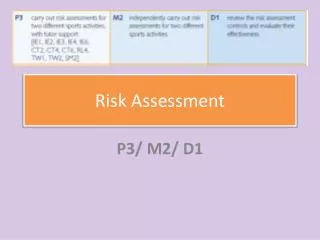
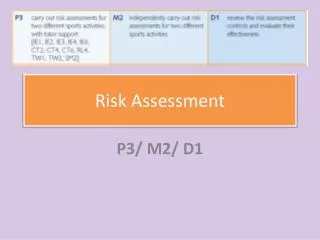
Risk Assessment P3/ M2/ D1
Risk: Possibility of something bad happening - Slipping on a wet floor… • Risk Assessment: Aims to make people aware of what could go wrong and how to prevent problems from happening. It examines: • Possible hazards that may occur • Risks involved • Likelihood of them happening • How the hazards could be prevented Action: Provide rubber matting to prevent slipping… Hazard: Potential source of danger - Fire, harmful substances, Jewellery when playing sport…
Conducting a risk assessment… First step is identifying the hazard/risk… Then use this formula: Likelihood x Severity Likelyhood: Severity: • Unlikely 1. No injury/ minor injury • Quite likely 2. Injury requiring medical assistance • Very likely 3. Major injury or fatality E.G- capsizing a kayak: Likelihood: 2 Quite likely Severity: 1. No injury Likelihood x Severity= 2
Conducting a risk assessment… • Control Measures: Minimise risk by introducing control measures where possible, to reduce the risk. E.G. coning off an area Is the risk Worth taking…??
Example Risk assessment form Location of risk assessment: Risk assessor’s name: Date:
So we are CRSYTAL clear… • You have to design a risk assessment for 2 Sports PASS • Doing that on your own= MERIT • Reviewing the effectiveness of your risk assessment will earn you a DISTINCTION. But it has to be detailed and cover all dimensions of your risk assessment. GOOD LUCK