

SlideServe
Menu
Préférences
© SlideServe · v2026

currents

onawa avatar
22 diapositives · 616 Views · Jul 31, 2014

currents. What are they?. A movement of ocean water that follows a regular pattern. There are two main categories of ocean currents: Surface Currents Deep Currents. Surface currents.
currents - slide 1
01 / 22currents
1 / 17

Télécharger la présentation

currents
Une image / un lien ci-dessous est fourni (tel quel) pour télécharger la présentation

Politique de téléchargement : le contenu du site vous est fourni TEL QUEL pour votre information et votre usage personnel ; il ne peut être vendu, concédé sous licence ni partagé sur d’autres sites sans l’accord de son auteur.Le contenu vous est fourni TEL QUEL, pour votre information et votre usage personnel uniquement. Téléchargez la présentation en cliquant sur ce lien. Lors du téléchargement, si vous ne parvenez pas à télécharger une présentation, l’éditeur a peut-être supprimé le fichier de son serveur.Pendant le téléchargement, si vous ne parvenez pas à obtenir une présentation, le fichier a peut-être été supprimé par l’éditeur.

F I N

Plus de contenu associé

Transcription de la présentation
  1. currents

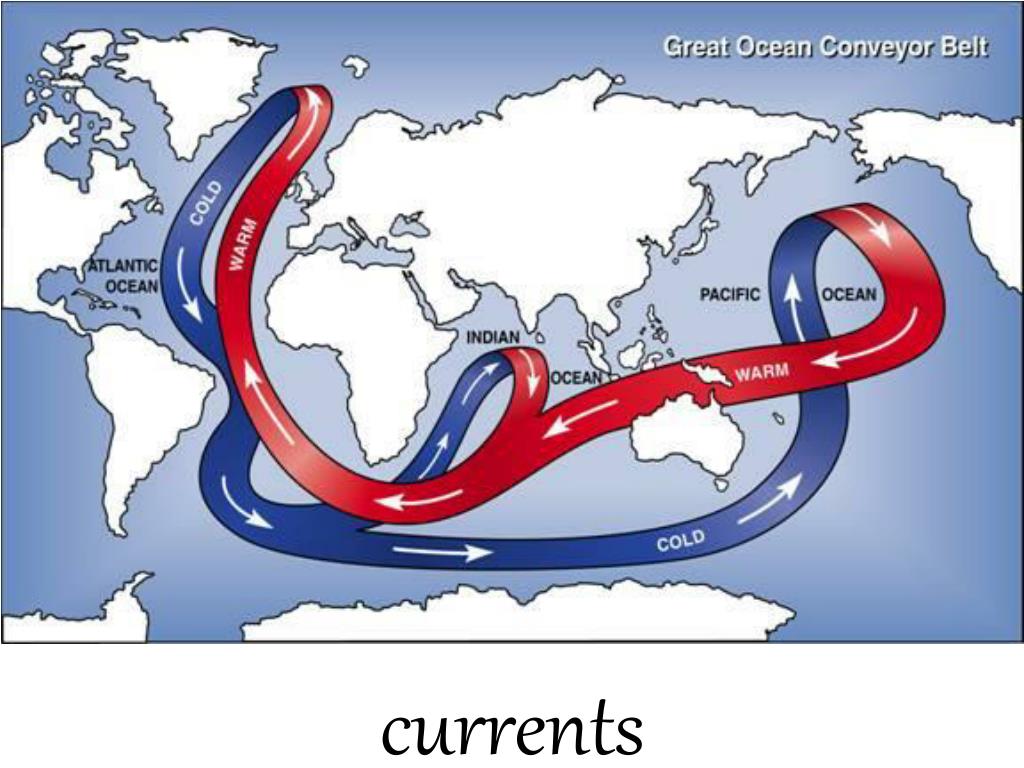
  2. What are they? • A movement of ocean water that follows a regular pattern. • There are two main categories of ocean currents: • Surface Currents • Deep Currents

  3. Surface currents • A horizontal movement of ocean water that is caused by wind and that occurs at or near the ocean’s surface • Controlled by three factors: • Global winds (influenced by weather) • The Coriolis Effect • Continental deflections

  4. More surface currents • Near the equator, winds blow ocean water EAST to WEST • Near the poles, winds blow ocean water WEST to EAST • The Coriolis Effect • The apparent curving of moving objects from a straight path due to the Earth’s rotation. • Northern Hemisphere: surface currents turn CLOCKWISE • Southern Hemisphere: surface currents turn COUNTER CLOCKWISE • When surface currents meet continents, the currents deflect, or change direction.

  5. Warm currents start at the equator and go north. Cold currents start at the poles and move toward the equator.

  6. Deep currents • Stream-like movements of ocean water located far below the surface • Form because of differences in density • Density can be influenced by salinity and temperature

  7. waves

  8. Anatomy of a wave

  9. How do they form? Most form as wind blows across the water’s surface and transfers energy to the water. The waves move through the water in the same direction as the energy, but the water molecules themselves stay behind, moving only in circular motions.

  10. Wave period • The time between the passage of two wave crests or two wave troughs at a fixed point.

  11. Types of Waves • Deep-water waves = waves that move in water deeper than ½ their wavelength • Shallow-water waves = waves that reach water shallower than ½ their wavelength

  12. White Caps Swells

  13. http://oceanexplorer.noaa.gov/edu/learning/9_ocean_waves/ocean_waves.html#slidehttp://oceanexplorer.noaa.gov/edu/learning/9_ocean_waves/ocean_waves.html#slide Make your own waves: http://education.nationalgeographic.com/education/multimedia/interactive/wave-simulator/?ar_a=1

  14. tides

  15. What are they? • Daily changes in the level of ocean water. • Influenced by the gravitational pull of the sun and the moon. • The moon’s pull is strongest on the part of the Earth directly facing the moon. The ocean on this part of the Earth “bulges” and so does the area on the opposite side of the Earth, causing high tides in these locations. The areas in between the two bulges experience low tides.

  16. Tidal range the difference between levels of ocean water at high tide and low tide (could be several feet in length)

  17. Low tide High tide

  18. Spring vs. neap tides • Spring tides tides with the largest daily tidal range and occur during the new and full moons (every 14 days), when the sun, Earth, and moon are all aligned. • Neap tides tides with the smallest daily tidal range and occur during the first and third quarters of the moon, when the sun, Earth, and moon are not in alignment.