Wireless Biometric Sensor for Remote Patient Monitoring
150 likes | 298 Vues
Our project presents a lightweight and portable wireless biometric sensor designed to enhance patient mobility in healthcare settings. This wrist-mounted device measures pulse, oxygen saturation, and skin temperature, transmitting data to a companion web application for real-time monitoring by doctors and care providers. The device not only triggers alarms for anomalous readings but also detects falls, ensuring patient safety. The presentation covers the project overview, design challenges, individual contributions, and includes a demonstration of the device's functionalities.


Wireless Biometric Sensor for Remote Patient Monitoring
E N D
Presentation Transcript
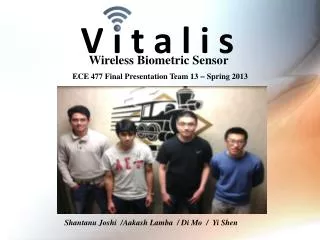
V i t a l i s ECE 477 Final Presentation Team 13 Spring 2013 Paste a photo of team members with completed project here. Annotate this photo with names of team members. Wireless Biometric Sensor Shantanu Joshi /AakashLamba / Di Mo / Yi Shen
Outline • Project overview • Block diagram • Design challenges • Individual contributions • Project demonstration • Questions / discussion
Project Overview • Most biometric sensors in hospitals are bulky and therefore reduce patient mobility. Our device solves this problem since it is lightweight and portable. • Our device is a wrist mounted biometric sensor that measures a patient’s pulse, oxygen-saturation and skin temperature. • A companion web-app receives data transmitted wirelessly from the device to our servers and thus allows the doctors and other care providers to remotely monitor the patient at all times. • Our device also has the ability to automatically trigger an alarm upon detecting anomalous readings. • In order to make our device more robust we have also added the ability to detect if the user has suffered a fall and appropriately raise an alarm.
Design Challenges • Portability • The PCB was made as small as possible (final size was 10.41 X 5.6 cms) • The device was battery powered and had on board recharging capabilities (used breakout boards for fuel gauge and on board recharging). To maximize battery life, used a 2000mAh battery • Device secured onto wrist using a neoprene band. Sensors placed so as to minimize discomfort to wearer Final Prototype
Design Challenges (2) • Alarm system • The micro detects whether readings for SPO2, temperature or pulse fall above or below preset thresholds • To notify patient, the OLED screen on the device turns red and clears only when the alarm has been transmitted via the web server • To reduce false alarms for fall detection, the accelerometer was mounted on the shoulder Accelerometer placement Alarm notification
Design Challenges (3) • Device needs to communicate to central server • The Wi-Fi module automatically connects to preprogrammed SSID • Since module must send GET requests to web app (hosted on Heroku which doesn’t accept incoming TCP connections), an intermediate web site had to be setup on a local computer running an apache server to bridge the module and web app Web app UI
Individual Contributions • Team Leader – Shantanu Joshi • Team Member 2 – AakashLamba • Team Member 3 – Mo Di • Team Member 4 – Yi Shen
Team Leader – Shantanu Joshi • Software lead • Created the website and setup server • Worked on prototyping sensors (accelerometer, temperature sensor, fuel gauge) • Worked on setting up Wi-Fi module • Involved with packaging • Fixed various hardware and software bugs related to I2C and our final PCB
Member 2 – AakashLamba • Tested and verified the power section of our design. Resolved power related bugs • Worked on packaging the device • Helped in debugging issues related to Wi-Fi and I2C • Debugged and tested final PCB • Worked on setting up the prototyping environment for PDIP package • Packaged and tested various sensors
Member 3 – Mo Di • Was the main force behind getting the SPO2 sensor up and running • Created CAD models for our design • Arranged for 3D printing, which used the CAD drawings Mo Di had prepared • Played a significant role in part selection • Involved closely with final packaging • Programmed the display for our device
Member 4 – Yi Shen • Was responsible for our PCB design. Created the PCB’s for both our power board and main module • Modified PCB design based on design review feedback • Populated the final PCB with components • Helped with debugging power related issues • Helped in packaging the SPO2 sensor • Set up team website
Project Demonstration • An ability to determine pulse and Spo2 readings from blood light absorption. • An ability to display the user’s vital statistics on the OLED screen. • An ability to remotely monitor a users medical status from a website via secure login. • An ability to activate an alarm automatically in response to anomalous readings of vitals. • An ability to detect if the user has suffered a fall.