Surgical Variations
This study analyzes surgical variations and outcomes involving trainee surgeons and anaesthetists from 1720 to 1730. The findings include data on surgery duration, types of procedures performed, and premedication usage. A significant portion of surgeries involved conventional methods, with shunts being utilized in cases of neurological deterioration. Additional insights reveal the frequency of patch applications and heparin usage during surgeries. The results highlight important trends and practices in surgical training, providing valuable information for improving trainee performance and patient outcomes.

Surgical Variations
E N D
Presentation Transcript
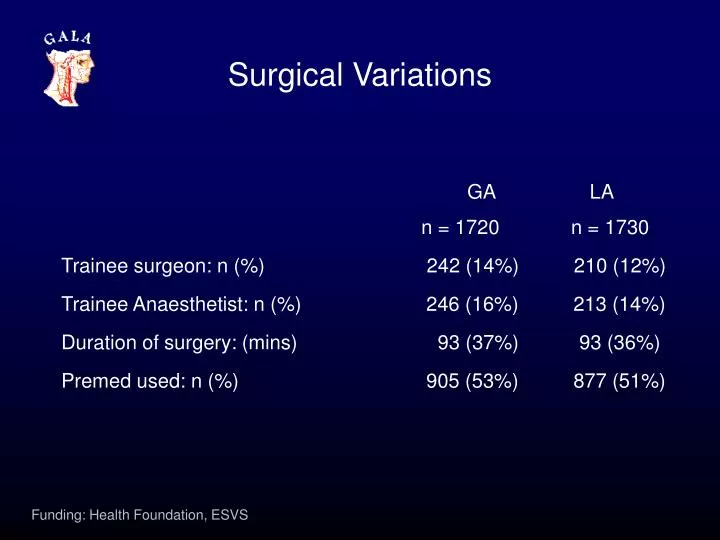
Surgical Variations GALA n = 1720 n = 1730 Trainee surgeon: n (%) 242 (14%) 210 (12%) Trainee Anaesthetist: n (%) 246 (16%) 213 (14%) Duration of surgery: (mins) 93 (37%) 93 (36%) Premed used: n (%) 905 (53%) 877 (51%)
Type of Surgery Conventional n (%) 1237 (78%) 1145 (72%) Eversion n (%) 317 (20%) 409 (26%) Exploration only n (%) 22 (1%) 14 (1%) Other n (%) 4 (0.2%) 9 (1%)
Use of Shunts GA LA Shunt used 738 (43%) 248 (14%) Reason for shunt Neurological deterioration 6* 150 Used routinely 369 35* Reduced TCD velocity 45 3* Unable to use TCD 48 5* Contra-lateral carotid occn./severe stenosis 38 5* Contra-lateral moderate stenosis 4 7* Low stump pressure 108 15* Recent stroke 5 3* Unusual/damaged arteries/veins 2 2* EEG/Evoked potential change 8 1* Hypotension 4 1* Brain oxygen level fall 1 0 Vein bypass 1 0 Unknown 89 21
Use of Patches GA LA Patch Used n (%) 861 (50%) 728 (42%) Heparin Used n (%) 1682 (98%)1678 (97%)