Factors Influencing Solute Dissolution Rates: Understanding Solutions and Concentration
This article explores the critical factors that determine the dissolution rate of a solute in a solvent. Essential terms such as solute, solvent, and solution are defined, emphasizing the role of agitation, temperature, and particle size in enhancing solubility. The behavior of gases in solutions, according to Henry's Law, and the impact of temperature and pressure on solubility are discussed. Additionally, concentration measures including molarity and molality are highlighted. Understanding these concepts is crucial for practical applications in chemistry.

Factors Influencing Solute Dissolution Rates: Understanding Solutions and Concentration
E N D
Presentation Transcript
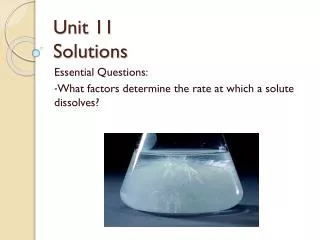
Unit 11Solutions Essential Questions: What factors determine the rate at which a solute dissolves?
Recall the Terms • Solute • The substance being dissolved (the one that changes phase) • Solvent • The substance doing the dissolving • Universal solvent is water • If it is a solution of 2 liquids or 2 solids, the solvent is the one in large quantity
Solution formation • Nature of the solute and the solvent • Whether a substance will dissolve • How much will dissolve • Factors determining rate of solution... • stirred or shaken (agitation) • particles are made smaller • temperature is increased • Why?
Making solutions • In order to dissolve, the solvent molecules must come in contact with the solute. • Stirring moves fresh solvent next to the solute. • The solvent touches the surface of the solute. • Smaller pieces increase the amount of surface area of the solute.
Temperature and Solutions • Higher temperature makes the molecules of the solvent move around faster and contact the solute harder and more often. • Speeds up dissolving. • Usually increases the amount that will dissolve (exception is gases)
Gases In Liquids • Henry’s Law - says the solubility of a gas in a liquid is directly proportional to the pressure of the gas above the liquid • Think of a bottle of soda • Removing the lid releases pres. • Equation: S1 S2 P1 P2 =
Liquids • Recall from Unit 9 • Miscible means that two liquids can dissolve in each other • water and antifreeze, water and ethanol • Immiscible means they can’t • oil and vinegar
How Much? • Solubility-The maximum amount of substance that will dissolve at a specific temperature (g solute/100 g solvent) • Saturated solution • Contains the maximum amount of solute dissolved • Unsaturated solution • Can still dissolve more solute • Supersaturated • Solution that is holding more than it theoretically can
Solubility Summary • For solids in liquids, as the temperature goes up-the solubility usually goes up • For gases in a liquid, as the temperature goes up-the solubility goes down • For gases in a liquid, as the pressure goes up-the solubility goes up
Concentration Is… • A measure of the amount of solute dissolved in a given quantity of solvent • Aconcentrated solution has a large amount of solute • Adilute solution has a small amount of solute • Thus, only qualitative descriptions • But, there are ways to express solution concentration quantitatively
Concentration of Solutions • Recall from Unit #4 • Molarity • Molality • Mole fraction • % by weight • % by volume • Recall how to make solutions
What is equal at Equilibrium? • Rates are equal • Concentrations are not. • Rates are determined by concentrations and activation energy. • The concentrations do not change at equilibrium. • or if the reaction is verrrry slooooow.
Law of Mass Action • For any reaction • jA + kBlC + mD • K = [C]l[D]mPRODUCTSpower [A]j[B]kREACTANTSpower • K is called the equilibrium constant. • is how we indicate a reversible reaction • Ignore pure solids and liquids
Law of Mass Action • Write the equilibrium constant expression for the reaction equation: NH3(aq) + HCl (aq) NH4+(aq) + Cl-(aq) • What is K when [NH3] = 0.100M, [HCl] = 1.00M, [NH4+] = 0.200M, [Cl-] = 0.100M
Ksp • Solubility product constant • Write dissociation equation • NaCl (s) Na+ (aq) + Cl-(aq) • Ksp= [Na+] [Cl-] • No denominator since it will always be a solid
Ksp • If your Ksp calculated value is = to actual value the solution is saturated • If your Ksp calculated value is greater than the actual value the solution is supersaturated • If your Ksp calculated value is less than the actual value the solution is unsaturated
Colligative Properties • Depend only on the number of dissolved particles • Not on what kind of particle
Vapor Pressure decreased • The bonds between molecules keep molecules from escaping. • In a solution, some of the solvent is busy keeping the solute dissolved. • Lowers the vapor pressure • Electrolytes form ions when they are dissolved = more pieces. • NaCl ® Na+ + Cl- (= 2 pieces) • More pieces = bigger effect
Boiling Point Elevation • The vapor pressure determines the boiling point. • Lower vapor pressure = higher boiling point. • Salt water boils above 100ºC • The number of dissolved particles determines how much, as well as the solvent itself.
Freezing Point Depression • Solids form when molecules make an orderly pattern. • The solute molecules break up the orderly pattern. • Makes the freezing point lower. • Salt water freezes below 0ºC • How much depends on the number of solute particles dissolved.
Why Molality? • The size of the change in boiling point is determined by the molality. • DTb= Kbx m x n • DTb is the change in the boiling point • Kb is a constant determined by the solvent • m is the molality of the solution. • n is the number of pieces it falls into when it dissolves.
What about Freezing? • The size of the change in freezing point is also determined by molality. • DTf= -Kfx m x n • DTf is the change in freezing point • Kf is a constant determined by the solvent • m is the molality of the solution. • n is the number of pieces it falls into when it dissolves.
Molar Mass • We can use changes in boiling and freezing to calculate the molar mass of a substance • Find: 1) molality 2) moles, and then 3) molar mass