Understanding Resonance in Tube Vibrations
Explore the concepts of open and closed tube resonators, standing wave patterns, nodes, and anti-nodes in the context of vibrational frequencies. Learn how these factors affect sound propagation in different tube configurations. Enhance your knowledge of acoustics with clear illustrations and detailed explanations.

Understanding Resonance in Tube Vibrations
E N D
Presentation Transcript
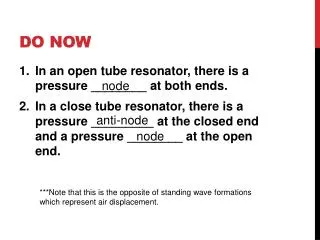
Do Now • In an open tube resonator, there is a pressure ________ at both ends. • In a close tube resonator, there is a pressure _________ at the closed end and a pressure ________ at the open end. node anti-node node ***Note that this is the opposite of standing wave formations which represent air displacement.
DO NOW • The diagram above depicts the standing wave pattern of the fundamental frequency or __________ harmonic of a _________ tube resonator. • The wavelength is equal to _________ times the length of the tube. L first closed four
Drawing Standing waves • The basis for drawing the standing wave patterns for air columns is that vibrational anti-nodes will be present at any open end and vibrational nodes will be present at any closed end. For a tube closed at one end… = nodes = anti-nodes In general, for the nthharmonic of a closed tube… Where n = 1,3,5…(odd)
Drawing Standing waves • The basis for drawing the standing wave patterns for air columns is that vibrational anti-nodes will be present at any open end and vibrational nodes will be present at any closed end. For a tube open at both ends… = nodes = anti-nodes In general, for an nth harmonic of an open tube… Where n = 1,2,3,4… (all integers)