SlideServe
Menu
Préférences
© SlideServe · v2026

Enhancing Road Safety Through Improved Radio Communication for Forestry Operations

oprah-cline avatar
8 diapositives · 247 Views · Nov 14, 2014

The "On the Road to Safety" initiative addresses the high incidence of crashes and near-misses in the bush due to poor communication among radio users. This resource emphasizes the need for standardized radio channels across the province, ensuring that trucks can communicate effectively regardless of their location or circumstances. By implementing clearly identified safety channels and educating users about proper radio procedures, the initiative aims to enhance safety on forestry roads, reduce accidents, and facilitate more coordinated responses in diverse situations.
Enhancing Road Safety Through Improved Radio Communication for Forestry Operations - slide 1
01 / 8Enhancing Road Safety Through Improved Radio Communication for Forestry Operations
1 / 17

Télécharger la présentation

Enhancing Road Safety Through Improved Radio Communication for Forestry Operations
Une image / un lien ci-dessous est fourni (tel quel) pour télécharger la présentation

Politique de téléchargement : le contenu du site vous est fourni TEL QUEL pour votre information et votre usage personnel ; il ne peut être vendu, concédé sous licence ni partagé sur d’autres sites sans l’accord de son auteur.Le contenu vous est fourni TEL QUEL, pour votre information et votre usage personnel uniquement. Téléchargez la présentation en cliquant sur ce lien. Lors du téléchargement, si vous ne parvenez pas à télécharger une présentation, l’éditeur a peut-être supprimé le fichier de son serveur.Pendant le téléchargement, si vous ne parvenez pas à obtenir une présentation, le fichier a peut-être été supprimé par l’éditeur.

F I N

Plus de contenu associé

Transcription de la présentation
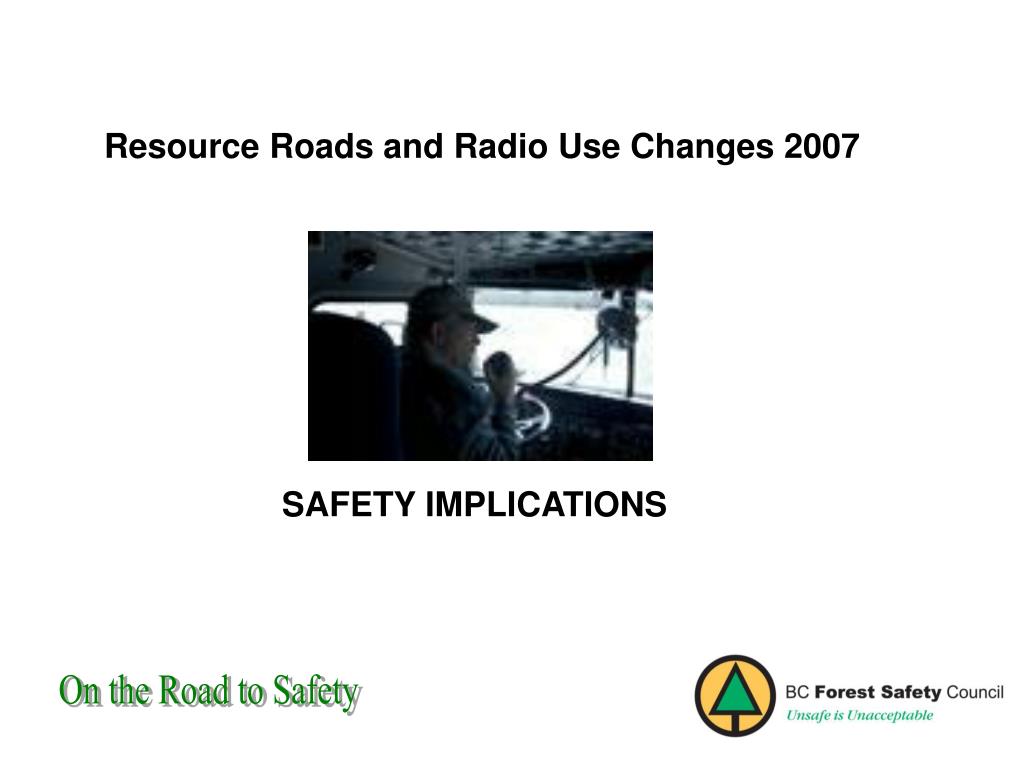
  1. Resource Roads and Radio Use Changes 2007 SAFETY IMPLICATIONS On the Road to Safety

  2. Why is this necessary? • too many crashes and close calls because of lack of communication or miscommunication • inconsistencies in calling procedures, signage, area frequencies • too many channel changes, especially in multiple user situations (other industries, more than one mill or contractor, etc) • mobility of trucks – moving around the province, working in different areas because of weather and seasonal changes, truck shortages, BCTS, longer hauls, 2 way hauls, mountain pine beetle, dimension logs, specialized mills.... On the Road to Safety

  3. Why is this necessary? • to reduce incidences of crashes in the bush because somebody was on the wrong channel • to ensure that wherever you are in the province, you have the right channel in your radio • to clear channels of non-forestry users Both these incidents were loaded trucks rearending other loaded trucks in adverse weather conditions – top, dust, Summer 06; bottom, fog, Winter 06. Fortunately both drivers lived; both weren’t on the right channel because they were short term hauls, so didn’t get channels programmed into their radios. On the Road to Safety

  4. How will this make the roads safer? • every radio-equipped vehicle will have the same resource road safety channels programmed in across the province • dedicated resource road safety channels will be clearly identified by specific signage, which will ensure clear communication • road channels will not be used for loading channels On the Road to Safety

  5. Forestry TruckSafe’sCommitment • education of road users around new radio • channels and usage • communication with road users through Forest Safety Council website, Rumblings newsletter, presentations, media, public meetings • exploring options on finding funding assistance for re-programming with new channels in pilot areas • communications with Industry Canada and BC Timber Sales re: radio-use related incidents on roads • development of regional “radio calling procedures” with stakeholders On the Road to Safety

  6. Forestry TruckSafe’s Commitment cont’d • to support BCTS contractors by providing information packages • to educate non-forestry resource road users – oil & gas, mining, guiding, tourism, service industry • to provide web-based on-going support that will allow road users to identify what channels are used where; who is using them, what the “rules of the road are” and what the radio calling protocols are • provide “hotline” support to deal with issues as they arise On the Road to Safety

  7. Because the bottom line is..... On the Road to Safety

  8. Contact Info: MaryAnne Arcand Director, Forestry TruckSafe & Northern Initiatives 1-877-324-1212 or 250-612-2267 arcand@bcforestsafe.orgwww.bcforestsafe.org “unsafe is unacceptable” On the Road to Safety