Understanding Earth's Atmospheric Layers: Troposphere to Thermosphere
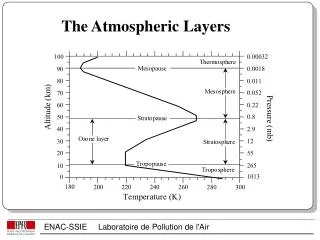
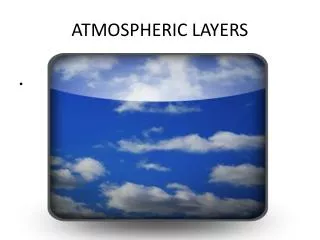
Explore the various layers of Earth's atmosphere, starting with the troposphere, where we experience weather and where 80% of the atmosphere's mass resides. As altitude increases, temperature and air pressure decrease, influencing air movement and humidity. The stratosphere protects us through the ozone layer, while the mesosphere is the coldest layer where meteors burn up. Finally, the thermosphere, the hottest layer, allows for radio communication and absorbs significant solar radiation. Learn how these layers interact and support life on Earth.

Understanding Earth's Atmospheric Layers: Troposphere to Thermosphere
E N D
Presentation Transcript
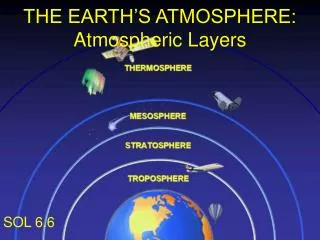
TROPOSPHERE We live here! (nearest Earth’s surface) Weather occurs here! Contains 80% of atmosphere’s mass Airplanes require density to promote lift As altitude increases, temperature & air pressure decreases Ex 1: top of mountain vs. sea level Temp. Variation creates air mass movement - (humidity, formations, etc…) Convection turns air over
STRATOSPHERE Above Troposphere Clear dry layer Contains Ozone layer (absorbs energy from the sun & turns it into heat) ….WARMS air above it …PROTECTS us from harmful UV rays as gas molecules absorb solar radiation
MESOSPHERE Coldest Layer “sandwiched” between the … Stratosphere : filters UV light (sun’s heat) & Thermosphere: absorbs UV rays (sun’s heat) Meteors burn up here Objects moving thru gas (air) encounters resistance as it pushes molecules out of the way 1. causing FRICTION 2. creating HEAT 3. Temp. rises, meteor GLOWS as it burns
THERMOSPHERE Above the Mesosphere Air is very thin Atoms are sparse & molecules are broken down- allows radio comm. Very hot! – Sunlight strikes this layer first – very sensitive to solar activity Can feel cold! Molecules are far apart but very DENSE so they ABSORB a significant part of the sun’s radiation.