The Election of 1800: A Turning Point in American Politics
80 likes | 201 Vues
The Election of 1800 marked a significant shift in American politics, leading to the rise of the Democratic-Republican Party and the presidency of Thomas Jefferson. Campaigning through letters rather than speeches, Jefferson and Burr faced off against Adams and Pinckney. The election resulted in an electoral deadlock resolved by Congress, prompting the 12th Amendment to separate votes for president and vice president. Jefferson's inaugural address aimed to unite a divided nation, laying the groundwork for a limited federal government and judicial review through the landmark Marbury v. Madison case.


The Election of 1800: A Turning Point in American Politics
E N D
Presentation Transcript
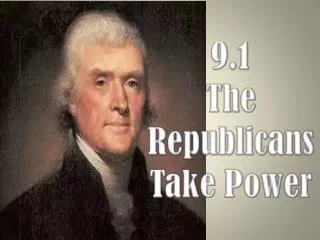
Republicans Take Power Chapter 9, Section 1
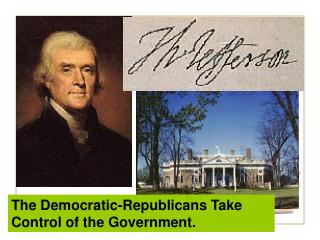
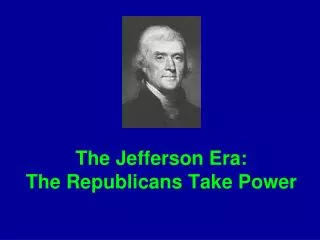
Election of 1800 • _____________ supported President Adams for 2nd term w/Charles Pinckney as VP from S. Carolina. • _____________ supported Thomas Jefferson for president and Aaron Burr for VP from New York. • Both candidates wrote letters to citizens and newspapers instead of touring & making speeches. • Letter-writing campaign was a battle: • Federalists said Jefferson was “godless”, even though he believed in freedom of religion. • Republicans warned people that Federalists would bring back a King and only represented interests of wealthy people w/property.
Election Deadlock • Electoral College voted—ended in a tie! • Between Jefferson and _______ (not John Adams). • B/C of tie ____________________ decided election. • At the time, electors voted for each presidential & _______________ candidate. • To prevent another showdown between presidential & vice-presidential candidates, Congress passed the ____________ in 1803. • Requires electors to vote for the president and vice-president on separate ballots.
Jefferson’s Inauguration • March 4, 1801—Jefferson dressed in everyday clothes for inauguration. • President Adams did not attend (slipped out of city b/c he did not want to watch Jefferson become president) • In speech, he tried to bring __________ and __________together. • Believed large federal govt. threatened state & individual liberty. • He believed in reducing power & size of fed. govt. • Adopted ideas from French philosophy called _____________ Laissez-faire—______________________________________
Jefferson’s Policies • Believed strength of U.S. was its _______________. • If people owned property, they would fight to protect their rights & preserve republic. • This reason caused Jefferson to want to acquire more land and expand to the west. • Distrusted standing armies & wanted to reduce size of _______ • Surrounded himself w/people that shared his Republican beliefs. • Sec. of State--_________________________ • Sec. of Treasury--_______________________ • Jefferson/Gallatin wanted to reduce natl. debt. • Slashed military spending. • Cut army by 1/3 & navy from 25 ships to ____. • Significantly lowered debt this way.
Jefferson’s Policies & Courts • Repealed certain taxes—including ___________. • All govt. funds would come from _____________. • Taxes on foreign imported goods. • 1801—federal govt. consisted of few hundred people. • Responsibility of natl. govt. should be limited to delivering mail, collecting customs duties, and conducting a _____ every 10 years. Judiciary Act of 1801 • __________ passed Jud. Act of 1801. • Set up regional courts w/16 judges & other officials. • John Adams made hundreds of appts. to these positions & Federalist-controlled Congress approved them. • Asked Sec. of State _____________ to become Chief Justice.
Jefferson’s Courts • Adams tried to shut Jefferson out of appt. process & ensure ________ would control courts. • Adams & Marshall spent all night writing paperwork for appts. • Appts. couldn’t take effect until papers were delivered. • Jefferson took office of March 4, some papers left undelivered. • Jefferson told Sec. of State __________ not to deliver them. • One paper was addressed to William Marbury • __________ believed he should be forced into judicial system b/c of paper not being delivered. • Marshall turned him down, saying Sup. Ct. does not have ability to decide his case according to the Constitution.
Marbury v. Madison • Marshall set out 3 principles of judicial review: • Constitution is supreme law of land. • Conflict between Const. and other laws, Const. must be followed. • The __________ branch has duty to uphold Const. • Marbury v. Madison established judicial review. • Allowed Supreme Court to rule on acts of other branches for the first time.