Download

1 / 13
130 likes | 263 Vues
The Rock Cycle is essential for ecological and biological functions, providing minerals, forming soil, and offering shelter. This educational overview defines rocks, explores their classifications—sedimentary, metamorphic, and igneous—and illustrates their formation processes, including weathering, transportation, and deposition. Each rock type plays a significant role in the environment and has unique characteristics. The cycle emphasizes the interconnectedness of geological processes and the continuous transformation of materials within the Earth. Discover the significance of rocks in life and the planet's system.

E N D
The Rock Cycle By Josh Wickersham, Alyssa Wong-Conway, Alex Levin, and Rachel Connolly
Ecological/Biological Roles • Plants and animals require minerals for life • Make up soil for plants • Source for precious minerals and metals • Provide shelter to small animals • Tools to early humans
What is a rock? • An assemblage of one or two minerals that form a part of the Earth’s solid body. • A rock normally connotes an individual specimen; it is detached from its outcrop so it has visible boundaries.
How much rock is there total? • Atmosphere – 0% • Lithosphere – 100% • Biosphere – 0% • Hydrosphere – 0%
Types of rocks - Sedimentary • Made of sand, shells, or other particles compressed into sediment and harden over time. • soft and breaks easily. • Ex: Conglomerate, limestone
Types of rocks - Metamorphic • Formed under the surface of the Earth from the metamorphosis that occurs in and under the crust • Often have ribbon-like layers, may have shiny crystals on their surface • Ex: Gneiss, marble
Types of rocks – Igneous • Formed from the crystallization of magma sometimes inside the Earth and other times erupts onto the surface through volcanoes (lava). • Ex: Basalt, obsidian
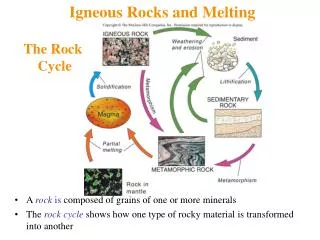
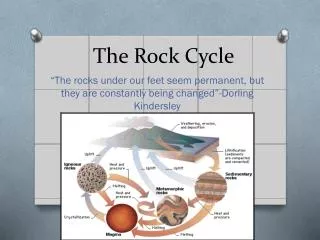
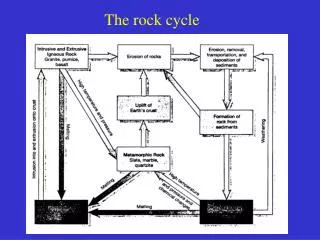
How sedimentary rocks are formed • Weathering- rocks wear down due to wind, man, or water • Transportation of sediments- rock is brought down a river bed • Deposition- rocks are deposited at the mouth of a river
How metamorphic rocks are formed • Sedimentary or igneous rock is put under intense heat and pressure and then goes through metamorphism. • Through weathering, transportation, and deposition, it becomes sediment again. • Through melting, they become magma.
How igneous rocks are formed • Magma undergoes cooling and crystallization and solidifies into igneous rock • Through weathering, transportation, and deposition, it becomes sediment again
Bibliography • Geology for Kids; September 22, 2008 http://www.kidsgeo.com/images/earths-lithosphere.gif • No title; September 22, 2008 http://www.windows.ucar.edu/earth/geology/images/rock_cycle_lg.jpg • The Rock Cycle; September 22, 2008 http://sunny.crk.umn.edu/courses/NatR-Holder/GEOL/PicsLogos3/RockCycle455.gif • Classifying Rocks and Minerals; September 22, 2008 http://www.bcssa.org/newsroom/scholarships/great8sci/Photos/Earth_Photos/metamorphic.jpg • Principles of Soils and Hydrology; September 22, 2008 http://www.cropsoil.uga.edu/soilsandhydrology/images/Granite.jpg • The Rock Cycle; September 22, 2008 http://www.moorlandschool.co.uk/earth/earth_science/utah_sandstone.jpg • Some Basic Concepts Underlying the Science of Geology; September 22, 2008 http://rst.gsfc.nasa.gov/Sect2/Sect2_1a.html • Interactives: Rock Cycle http://www.learner.org/interactives/rockcycle/