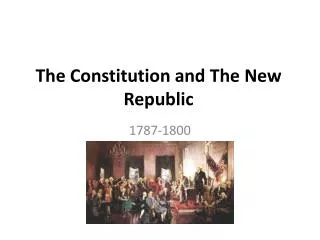
The Constitution and the New Republic (1787-1800): Unity Amidst Division
170 likes | 299 Vues
This overview explores the challenges and triumphs faced by the United States in creating and establishing the Constitution between 1787 and 1800. It examines the weaknesses of the Articles of Confederation, the pivotal Philadelphia Convention debates, key compromises, and the emergence of political parties. The document highlights the significance of the Constitution in unifying diverse states and philosophies, despite early political strife and controversies such as the Alien and Sedition Acts. Ultimately, it reflects on the enduring framework that allowed a fledgling republic to persevere.


The Constitution and the New Republic (1787-1800): Unity Amidst Division
E N D
Presentation Transcript
The Constitution and The New Republic 1787-1800
Objective Question Can the states unite and prosper under one constitution, regardless of separating political viewpoints and philosophies?
Early Issues: Articles of Confederation • 1 house Congress • No separated branches of government Who came up with the checks and balance system?
Cont… • Poor European relations • Britain inhibit trade • Treaty of Paris: Give land back to Loyalists, repay foreign debt • Economic Depression • Annapolis Convention– Discuss rethinking things
"Article III. The said states hereby severally enter into a firm league of friendship with each other, for their common defence, the security of their Liberties, and their mutual and general welfare, binding themselves to assist each other, against all force offered to, or attacks made upon them, or any of them, on account of religion, sovereignty, trade, or any other pretence whatever."
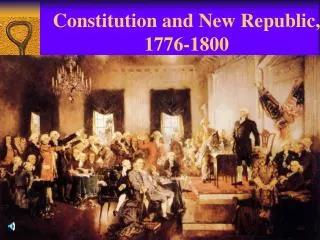
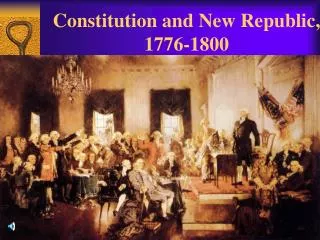
Creating the Constitution • 1787 Philadelphia Convention (which state refused to send delegates?) • Main issues • Representation Virginia Plan + New Jersey Plan = Great Compromise • Slavery 3/5 Compromise • Trade Commercial Compromise • Powers and Election of president 4 yr term; Electoral College • Ratification September 17, 1787
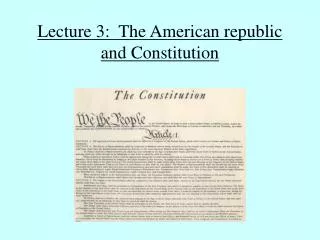
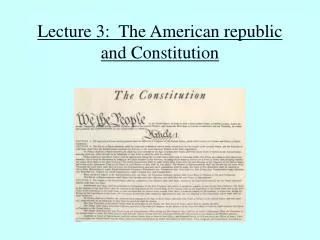
What’s this called? “We the People of the United States, in Order to form a more perfect Union, establish Justice, insure domestic Tranquility, provide for the common defence, promote the general Welfare, and secure the Blessings of Liberty to ourselves and our Posterity, do ordain and establish this Constitution for the United States of America”
Different Parties Federalists Democratic Republicans (Anti-Federalists) South and West, small farmers, frontier settlers States’ Rights – avoid domineering Government (like Britain) Bill Of Rights Jefferson • Atlantic Coast, city folks • Greater Federal power – preserve Union • Federalist Papers – support Constitution • Hamilton "The alternate domination of one faction over another, sharpened by the spirit of revenge natural to party dissention, which in different ages & countries has perpetrated the most horrid enormities, is itself a frightful despotism.” – G. Washington, 1796 Was he right?
John Adams Thomas Jefferson
Post Washington (Washington Post. Ha.) • John Adam’s win election (Federalist) • Naturalization Act: lengthened time to obtain US citizenship • Alien Acts: Pres can detain/deport dangerous aliens/immigrants • Sedition Act: censor newspapers from criticizing Pres/Congress Tools used to weaken Democratic-Republican party
Nullification • Republicans oppose these acts (violate first amendment) • States united under a “compact” forming Federal Government • If Gov break compact, states have right to nullify law • Kentucky and Virginia Resolutions 1799
Fall of The Feds • Alien & Sedition Acts • No war against France, but high taxes for defense anyways • 1801 Jefferson (Republican) President • Revolution of 1800 (big deal that no fighting occurred)
THUS • The constitution, regardless of disagreements and a rough start, proved effective for the new US government.