Download
1 / 15
150 likes | 270 Vues
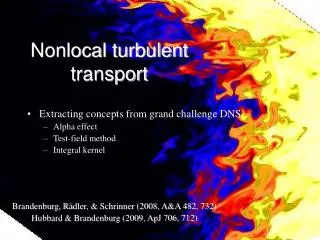
This study explores nonlocal turbulent transport through the lens of direct numerical simulations (DNS) and the alpha effect within the test-field method. We delve into the mean-field equations and fluctuations in response to arbitrary mean fields, illustrated with results from Roberts flow. We discuss the dependence of the coefficients on wave number and validate our findings against previous models. Additionally, we address the significance of nonlocality in turbulence and its implications for constructing the electromotive force (EMF), leading to practical applications in astrophysical contexts.

E N D
Nonlocal turbulent transport • Extracting concepts from grand challenge DNS • Alpha effect • Test-field method • Integral kernel Brandenburg, Rädler, & Schrinner (2008, A&A 482, 732) Hubbard & Brandenburg (2009, ApJ 706, 712)
Test-field method: aij and hij tensors Original equation (uncurled) Mean-field equation fluctuations Response to arbitrary mean fields
Constand and linear test fields Example:
Result for Roberts flow But: a and ht should have been constants
Periodic test fields Example:
Result for Roberts flow Now: a and ht are k-dependent!
Validation & k-dependence SOCA SOCA result Brandenburg, Rädler, Schrinner (2008, A&A) normalize
Remember: a and ht are really kernels IAU Symp 71 in Prague, Czechoslovakia (1975)
Confirmed also for other cases Mitra et al. (2009 A&A 495, 1) U=(0, Sx, 0) Sh=S/uk=-0.13 ~1/[1+(k/kf)2] seems now compulsory Significant when MFM would produce SS Unconfirmed for large k Smagorinsky scaling ~1/k-4/3 Madarassy & Brandenburg,, (2010, PRE)
Nonlocality in time Hubbard & Brandenburg (2009, ApJ 706, 712)
Conclusions • Nonlocality is of practical relevance • Reconstructing the full EMF (Chatterjee et al. 2010) Reconstruction with k up to 16 Reconstruction with basic mode Original EMF