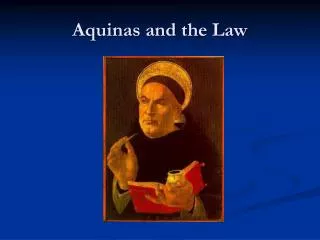
Aquinas and the Law
630 likes | 966 Vues
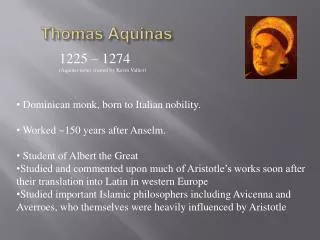
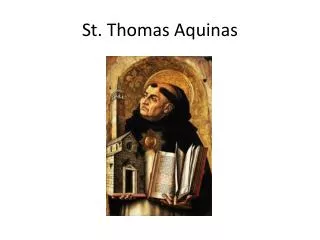
Aquinas and the Law. Introduction. Introduction. Thomas Aquinas ( 1225 to 1274) Born into a noble Neapolitan family, but joined the Dominican order He was canonised in 1323 Doctor Angelicus, Doctor Universalis His major work is the Summa Theologiae. Background. Background. Background.


Aquinas and the Law
E N D
Presentation Transcript
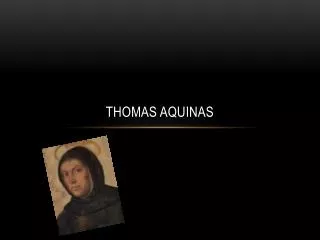
Introduction • Thomas Aquinas (1225 to 1274) • Born into a noble Neapolitan family, but joined the Dominican order • He was canonised in 1323 • Doctor Angelicus, Doctor Universalis • His major work is the Summa Theologiae
Background • Manorial System
Background • Feudalism
Background • Church Medieval illustration of the Donation of Constantine, featuring Pope Sylvester (left) and the Emperor Constantine (right)
Background • Chivalric Virtues prowess courage honesty loyalty generosity faith courtesy kill dragons
Background • Chivalric Virtues rare
Law • Stoics • Natural functions normativity Natural Law
Law • Stoics • Natural functions normativity Natural Law • Jews • God’s commands revealed to us
Law • Stoics • Natural functions normativity Natural Law • Jews • God’s commands revealed to us • Romans • Inspiration of the universal Roman Law
Law • Aquinas’s definition … an ordinance of reason for the common good, made by him who has care of the community, and promulgated
Law • Aquinas’s definition … an ordinance of reason for the common good, made by him who has care of the community, and promulgated • Justified in terms of a final end
Law • Aquinas’s definition … an ordinance of reason for the common good, made by him who has care of the community, and promulgated • Justified in terms of a final end • Rational
Law • Four Kinds of Law • Eternal • Natural • Divine • Positive
Eternal Law • God’s rational plan for the world it is evident that the whole community of the universe is governed by God’s mind … Since God’s mind does not conceive in time, but has an eternal concept … it follows that this law should be called eternal
Natural Law • Non-rational creatures must obey Eternal Law
Natural Law • Non-rational creatures must obey Eternal Law • Rational creatures have free will, and can disobey Eternal Law
Natural Law • Non-rational creatures must obey Eternal Law • Rational creatures have free will, and can disobey Eternal Law • We experience Eternal Law normatively
Natural Law • Non-rational creatures must obey Eternal Law • Rational creatures have free will, and can disobey Eternal Law • We experience Eternal Law normatively • The normative aspect of Eternal Law is Natural Law
Natural Law • Normative and Descriptive Laws
Natural Law • Normative and Descriptive Laws • Descriptive laws describe how things do behave • Example: Law of Gravity
Natural Law • Normative and Descriptive Laws • Descriptive laws describe how things do behave • Example: Law of Gravity • Normative laws specify how people should behave • Example: Ten Commandments
Natural Law • Normative and Descriptive Laws • Descriptive laws describe how things do behave • Example: Law of Gravity • Normative laws specify how people should behave • Example: Ten Commandments • Aquinas claims that Eternal Law is both descriptive and normative
Natural Law • Natural Inclinations
Natural Law • Natural Inclinations • How can we discover the content of Natural Law?
Natural Law • Natural Inclinations • How can we discover the content of Natural Law? • God gave us natural inclinations which are reliable guides to the Natural Law
Natural Law • Natural Inclinations • How can we discover the content of Natural Law? • God gave us natural inclinations which are reliable guides to the Natural Law • The basic principle of Natural Law is: Seek out good and avoid evil
Natural Law • Natural Inclinations • How can we discover the content of Natural Law? • God gave us natural inclinations which are reliable guides to the Natural Law • The basic principle of Natural Law is: Seek out good and avoid evil • Fundamental good things are: Life, procreation, knowledge, society, reasonable conduct
Natural Law • Precepts
Natural Law • Precepts • We can’t do just anything to acquire these goods
Natural Law • Precepts • We can’t do just anything to acquire these goods • By examining our actions, their goals and their circumstances, we can distinguish between proper and defective ways of trying to obtain what is fundamentally good in human life
Natural Law • Precepts • We can’t do just anything to acquire these goods • By examining our actions, their goals and their circumstances, we can distinguish between proper and defective ways of trying to obtain what is fundamentally good in human life • There is no method given that yields principles that cover everything and every circumstance
Natural Law • Primary Precepts • Derivations of the natural law that must always be true and demonstrably so to anyone who is able to understand the words in which the law is formulated. • Example: The intentional killing of innocents, adultery, sodomy or blasphemy
Natural Law • Secondary Precepts • Derivations of the natural law that are rationally derived from primary precepts, but depend upon circumstances • Example: Reasoning of this kind underlies Catholic condemnations of abortion, euthanasia, genetic engineering. • They are defective ways of dealing with primary good of life.
Natural Law • Critique • Is it a confusion of Normative and Descriptive rather than a combination?
Divine Law • Some elements of Eternal Law can only be known through Revelation
Divine Law • Some elements of Eternal Law can only be known through Revelation • This distinguishes Christian knowledge of the Good from pagan
Positive Law • The law as enacted by man
Positive Law • The law as enacted by man • Constraints • clear, publicly known, and capable of general obedience • A law against lying is unreasonable • A law against perjury is something we could obey.
Positive Law • The law as enacted by man • Constraints • clear, publicly known, and capable of general obedience • A law against lying is unreasonable • A law against perjury is something we could obey • the possibility of enforcement • A law against gluttony is unreasonable
Natural Law Gluttony Positive Law Murder Voting Positive Law
Moral Problems • The Doctrine of Double Effect
Moral Problems • The Doctrine of Double Effect • According to Aquinas (ST II II 64.7) the act of self-defence may have two effects: one, the saving of one’s life; the other, the slaying of the aggressor … if a man in self-defence uses more than necessary violence, it will be unlawful, whereas, if he repels force with moderation, his defence will be lawful
Moral Problems • The Doctrine of Double Effect • According to Aquinas (ST II II 64.7) the act of self-defence may have two effects: one, the saving of one’s life; the other, the slaying of the aggressor … if a man in self-defence uses more than necessary violence, it will be unlawful, whereas, if he repels force with moderation, his defence will be lawful • Basically: you may do something with a bad effect if that isn’t your intention in acting
Moral Problems • The Doctrine of Double Effect • According to Mangan A person may perform an action that he foresees will produce a good effect and a bad effect provided that four conditions hold: • the action in itself is good or at least indifferent • the good effect and not the evil effect is intended • the good effect is not produced by means of the evil effect • there is a sufficiently grave reason for permitting the evil effect
Moral Problems • The Doctrine of Double Effect • Example 1: Civilian casualties

![Aquinas [ 1 ]](https://cdn2.slideserve.com/4797220/aquinas-1-dt.jpg)