Download
1 / 1
20 likes | 164 Vues
The NOMAD experiment at CERN (1993-1998) investigated neutrino oscillations, addressing the "solar neutrino problem" where only half of expected solar neutrinos reach Earth. This phenomenon was linked to the oscillation of neutrinos, requiring differences in mass squared among the three species. NOMAD specifically searched for oscillations between muon neutrinos and tau neutrinos over short distances, utilizing advanced detectors such as drift chambers and electromagnetic calorimeters. Significant findings included insights on dimuon production and L hyperon creation, laying groundwork for future research.

E N D
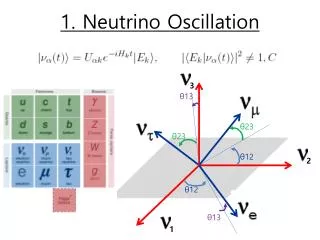
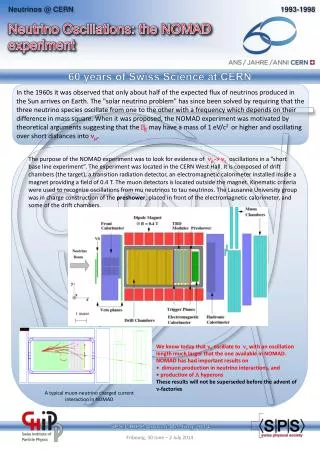
Neutrinos @ CERN • 1993-1998 Neutrino Oscillations: the NOMAD experiment In the 1960s it was observed that only about half of the expected flux of neutrinos produced in the Sun arrives on Earth. The "solar neutrino problem" has since been solved by requiring that the three neutrino species oscillate from one to the other with a frequency which depends on their difference in mass square. When it was proposed, the NOMAD experiment was motivated by theoretical arguments suggesting that the may have a mass of 1 eV/c2 or higher and oscillating over short distances into nm. The purpose of the NOMAD experiment wasto look for evidence of nm -> ntoscillations in a “short base line experiment”. The experiment waslocated in the CERN West Hall. It is composed of drift chambers (the target), a transition radiation detector, an electromagnetic calorimeter installed inside a magnet providing a field of 0.4 T. The muon detectors is located outside the magnet. Kinematic criteria were used to recognize oscillations from mu neutrinos to tau neutrinos. The Lausanne University group was in charge construction of the preshower, placed in front of the electromagnetic calorimeter, and some of the drift chambers. We know todaythatnm oscillate to ntwith an oscillation lengthmuchlargerthat the one available in NOMAD. NOMAD has had important results on • dimuon production in neutrino interactions, and • production of Lhyperons Theseresultswill not besupersededbefore the advent of n-factories A typicalmuon-neutrinochargedcurrent interaction in NOMAD