Impact of Nutrients and Dissolved Oxygen on Great Bay Estuary: Trends and Concerns
This report examines the effects of nutrient loading and dissolved oxygen levels in the Great Bay estuary, focusing on eutrophication and its positive and negative impacts. Notably, nitrogen concentrations have increased significantly over recent years, with a 42% increase in total nitrogen load and a 44% rise in dissolved inorganic nitrogen levels over 28 years. The study identifies areas needing further research, including the lack of data on phytoplankton production and oxygen depletion in various regions of the estuary, underscoring the need for improved monitoring and models.

Impact of Nutrients and Dissolved Oxygen on Great Bay Estuary: Trends and Concerns
E N D
Presentation Transcript
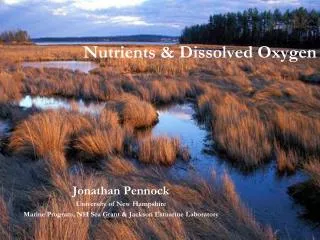
Nutrients & Dissolved Oxygen Jonathan Pennock University of New Hampshire Marine Program, NH Sea Grant & Jackson Estuarine Laboratory
EutrophicationPositive Versus Negative Effects Oligotrophic Mesotrophic Eutrophic Dystrophic Phytoplankton Zooplankton Pelagic Fish Bottom Oxygen Benthos Benthic Fish
NOAA Estuarine Eutrophication Assessment Bricker 1999
Nitrogen in Great Bay • Q Have nitrogen concentrations in Great Bay changed significantly over time? Yes. The total nitrogen load to the Great Bay Estuary increased by 42% in the past 5 years. Dissolved inorganic nitrogen concentrations have increased in Great Bay by 44% in the past 28 years. • A
Total N Load 2002-2004 1,097 tons/yr 2006-2008 1,558 tons/yr Percent Change 42% Nitrogen Loads to Great Bay WWTFs 484.64 tons/yr 31% Groundwater 31.28 tons/yr 2% Tributaries and Runoff 1014.00 tons/yr 65% Atmospheric 27.92 tons/yr 2% • Data Source: PREP
Dissolved Nitrogen Dissolved Inorganic Nitrogen 44% increase over 28 years Ru Morrison
Chlorophyll-a & Suspended Solids Chlorophyll-a 28% increase over 28 years Suspended Solids 123% increase over 28 years
Dissolved Oxygen How often do dissolved oxygen levels in the estuary fall below state standards? Rarely in the bays and harbors but often in the tidal rivers. • Q • A
Dissolved Oxygen Concentration Ru Morrison
Dissolved Oxygen Diel Variability Phil Trowbridge
Data Gaps • Additional Sampling Stations in the Bay are Needed to Provide Better Insight and Averages for the Bay Proper… • A Robust Nutrient Loading/Sink Model is Needed to Determine Specific Nutrient Loading and Ultimate Fate of Nutrients in the System… • There are No Data on Phytoplankton Production in the Estuary… • …