Innovative Soft Electronics: Advancements in Sensors and Adaptive Materials
This publication explores the cutting-edge realm of soft robotics, wearable computing, and mechanically adaptive materials. Researchers R.J. Wood, G.M. Whitesides, and Z. Suo highlight advancements in electronic skin for tactile sensing and soft, hyperelastic circuits for stretchable computing. These innovations promise to revolutionize tools for exploration, disaster relief, personal electronics, and assistive medicine, enabling machines to adapt their shape and properties in response to environmental changes. Harvard MRSEC showcases all-compliant pressure, strain, and curvature sensors using conductive liquid embedded in silicone elastomers for enhanced durability and flexibility.

Innovative Soft Electronics: Advancements in Sensors and Adaptive Materials
E N D
Presentation Transcript
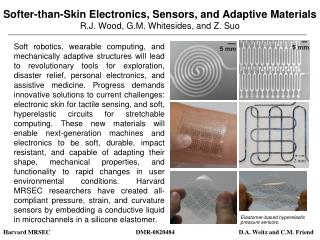
Softer-than-Skin Electronics, Sensors, and Adaptive MaterialsR.J. Wood, G.M. Whitesides, and Z. Suo Soft robotics, wearable computing, and mechanically adaptive structures will lead to revolutionary tools for exploration, disaster relief, personal electronics, and assistive medicine. Progress demands innovative solutions to current challenges: electronic skin for tactile sensing, and soft, hyperelastic circuits for stretchable computing. These new materials will enable next-generation machines and electronics to be soft, durable, impact resistant, and capable of adapting their shape, mechanical properties, and functionality to rapid changes in user environmental conditions. Harvard MRSEC researchers have created all-compliant pressure, strain, and curvature sensors by embedding a conductive liquid in microchannels in a silicone elastomer. Elastomer-based hyperelastic pressure sensors. Harvard MRSEC DMR-0820484 D.A. Weitz and C.M. Friend