Understanding the Distributive Property in Multiplication
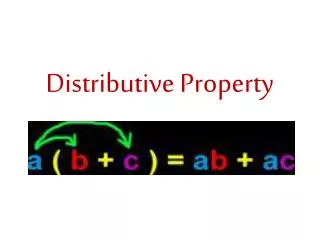
The Distributive Property states that multiplying a sum by a number is equivalent to multiplying each addend by that number, then adding the products together. For example, in the expression 7 x (10 + 5), we can transform it to (7 x 10) + (7 x 5), yielding 70 + 35 = 105. To apply this property, identify the sum, break it down into simpler addends, multiply each by the factor, and finally, sum the partial products. This fundamental property is represented as a(b + c) = ab + ac for any values of a, b, and c.

Understanding the Distributive Property in Multiplication
E N D
Presentation Transcript
Distributive Property • The property that states that multiplying a sum by a number is the same as multiplying each addend in the sum by the number and then adding the products. • 7 x 15 7 x (10 + 5) (7 x 10) + (7 x 5) 70 + 35 105
Distributive Property • Decide which number will be the sum • Take that sum apart into easier addends (expanded notation recommended) • Multiply each addend with the factor • Add the partial products together Distributive Property is represented as… a(b + c) = (a x b) + (a x c), a(b + c) = ab + ac for any value of a, b, and c