Ionic Formula Writing
Learn about writing ionic formulas like H2O or NaCl. Understand the charge of atoms, combining elements, balancing charges, and using the Crossover Method for compounds like Li2S. Get tips on reducing subscripts, handling polyatomic ions, and solving naming problems.

Ionic Formula Writing
E N D
Presentation Transcript
H2O • H2 means 2 Hydrogen atoms • O means 1 Oxygen atom • Why?
NaCl • Na - 1 Sodium • Cl - 1 Chlorine • Why?
Columns = Groups Rows = Periods 1+ 2+ 3+ 4± 3- 2- 1-
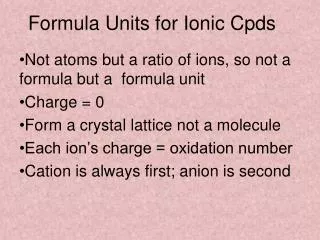
So what about NaCl? The goal of every atom is to be charge free. So they combine until they have a charge of 0 Sodium Chloride Na Cl +1 -1 = 0 +1 + -1 Na Cl NaCl + =
That still doesn’t explain how we got H2O Hydrogen Oxygen The goal of every atom is to be charge free. So they combine until they have a charge of 0 O H -2 +1 +1 + +1 + -2 = 0 H H O HHO H2O + + = =
So . . . . • What is the formula if Lithium combined with Sulfur? • Lithium has a charge of 1+ and sulfur has a charge of 2- so you would need two lithiums to make the total charge zero. • Li2S
Crossover Method • Reliable way to be sure of answers for naming problems. • Radium and Iodide
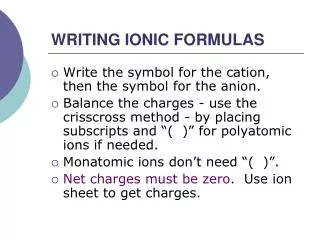
Big Rules • All Compounds are neutral • Charges up top (superscript);Amount on the bottom (subscript) • Reduce subscripts to their lowest ratio • Put Polyatomic ions in parenthesis so their amounts don’t get lost • SiF62- (SiF6)2-
Try These • Combine: • Co2+ and CN- • Mg2+ and IO3- • Ni 2+ and I- • Ag+ and F- • Be2+ and N3-
Try These • Write the chemical formula: • Magnesium Bisulfate • Hydrogen Cyanide • Beryllium Carbonate • Rubidium Nitrate • Plumbous Binoxalate