Understanding Ionic Compounds: Formulas, Naming, and Characteristics
This guide explores the nature of ionic compounds, focusing on their structural units rather than individual atoms. Ionic compounds form through the arrangement of cations and anions within a crystal lattice, with an overall charge of zero. Monoatomic and polyatomic ions are discussed, including examples such as sodium hydrogen carbonate and ammonium nitrate. The naming conventions for ionic compounds are outlined, emphasizing the order of cations and anions, the use of suffixes for monoatomic anions, and the inclusion of Roman numerals for transition metals.

Understanding Ionic Compounds: Formulas, Naming, and Characteristics
E N D
Presentation Transcript
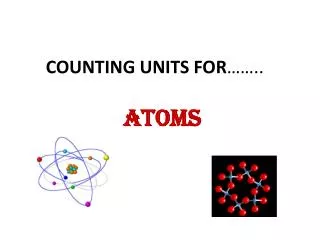
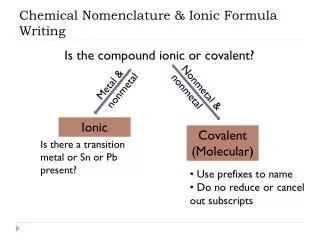
Formula Units for Ionic Cpds Not atoms but a ratio of ions, so not a formula but a formula unit Charge = 0 Form a crystal lattice not a molecule Each ion’s charge = oxidation number Cation is always first; anion is second
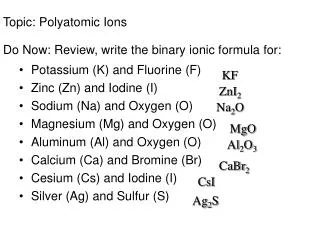
Monoatomic Ions • A one atom ion. • Two monoatomic ions = binary compound • KCl MgCl2 Na3Cl
Polyatomic Ions • More than 1 atom but act like 1 ion • Usually OXYANIONS • Have 1 oxidation number • Use parenthesis to show more than 1 • Never change the subscripts w/in the p.a. ion • Ex: sulfuric acid = H2SO4 magnesium chlorate Mg(ClO3)2 (use table 8.6 on pg. 224)
Quick Check • What’s the correct formula for: • Sodium hydrogen-carbonate • Magnesium hydroxide • Ammonium nitrate • Ammonium oxide • Hydrogen peroxide • Calcium phosphate
Naming Ionic Cpds • Cation first; anion second • Monoatomic anion = -ide • Polyatomic ion = look up name on chart • Cations = use element’s name • Transition metals = include Roman numerals
Quick Check • Name the following: • AgNO3 • CuCrO4 • KI • Ca(ClO4) 2