Enhancing Quality Assurance Systems in Higher Education: A Comprehensive Approach
The “QUASYS” project at the University of Zagreb, led by Prof. Helena Jasna Mencer, focuses on developing an effective Quality Assurance System in higher education. It aims to address challenges such as accreditation, curriculum development, and internal evaluations of institutional practices. The project seeks to establish clear quality indicators, improve the mobility of students and faculty, and enhance cooperation with the market and alumni. Key goals include promoting competitiveness, refining evaluation processes, and overcoming resistance to change to achieve higher educational standards.

Enhancing Quality Assurance Systems in Higher Education: A Comprehensive Approach
E N D
Presentation Transcript
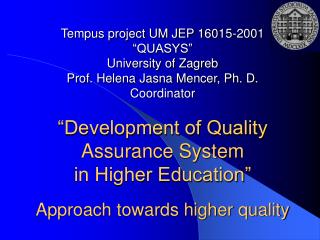
Tempus project UM JEP 16015-2001“QUASYS”University of ZagrebProf. Helena Jasna Mencer, Ph. D.Coordinator“Development of Quality Assurance System in Higher Education”Approach towards higher quality
Evaluation includes following procedures: • Accreditation of higher education institution • Preparing, accepting and developing curricula • (External and internal) evaluation of institution - organisational structure, teaching process, scientific research, management • Criteria for promotion, election and re-election • Evaluation of professors and students
What are special indicators of quality in higher education? • Level of existing quality assurance system which ensures quality • Working results • European and world trends in higher education (to raise the culture level which contributes to the quality) • Integration into the University and the University itself into European Higher Education Area
Current state • Legislation Law 1993 Amendments 1995 2000 New law 2003 • University Statute • Rules, regulations and provisions
Important criticisms and objections to the current state • Insufficiently defined procedures of accreditation and evaluation of institution • Resistance of the academic community towards change • Enrolment policy does not receive due attention • Lack of student and teacher mobility (the way towards integrated University is long-lasting and difficult)
Important criticisms and objections to the current state • Slow curricula change, insufficient reviewing culture • Teaching and professional activity is not adequately evaluated in relation to scientific activity • Constant quality monitoring didn’t start operating (quality indicators have not been systematically gathered and correctly interpreted) • Excellence and quality is not rewarded
Developmental goals • Development and implementation of an all-encompassing and effective quality assurance system (from national, university and faculty level, to students, teachers and scientists) • High standards and criteria
Development of quality assurance system focuses on: • Adequate organisation and management • Adequate financing • Sustainable personnel policy • Enrolment policy (market and society needs) • Teaching process (increasing mobility – Bologna process, curricula development, new learning and teaching methods) • Relations with surroundings
Expected outcomes • Change of rules, recommendations, criteria and even the Law on Higher Education • Definition of institutional quality indicators and criteria for programme, teachers’, students’ and scientific and research activity • More rightfuland sufficient financing • Encouragement of the competitiveness spirit
Expected outcomes • Increasing involvement of the University into domestic and international multidisciplinary and interdisciplinary projects • Achieved qualifications and knowledge of students and teachers which is suitable to the demands of the market and society
Monitoring of expected indicators of progress, taking into account self-evaluation and annual reports • Higher graduation and lower drop out • Number of students abandoning their studies • Students’ and teachers’ mobility • Projects with European universities (especially joint studies) • Projects with the market • Employability • Co-operation with alumni • Co-operation with the market
Conditions, obstacles and risks • Resistance to the change how to lose resistance - providing improved information by explaining the need for change and benefits that changes bring - political support (Ministry of Higher Education, National Council for Higher Education, Parliament) - University support (rector, Senate)
Strategic steps • Self-evaluation of quality indicators, students’ evaluation of the teachers, ways of evaluating students etc. are fundamental for development of corrective procedures, as well as rewarding procedures • Redefining the roles and tasks in the quality assurance system at the national, university and faculty level (subsidiarity in management)
Strategic steps • Distributing competencies, activities and responsibilities to the corresponding levels (University, faculty) • Setting up a sustainable enrolment policy • Redefining criteria for further promotion of university teachers • Redefining competencies of the electing institutions - commissions, faculty councils(leadership)
Strategic steps • Redefining the role of science classification • Development of internal institutional model of evaluation • Development of scientific criticism and reviewing culture
Measures • Engagement of the academic community (decrease of resistance to changes) • Changes in Law and its underlying acts • Changing the enrolment policy (financing of students, discussions on higher education as a public vs. private good)
Measures • Redefining of evaluation protocol • Recognition and awarding of excellence, abandoning “levelling” • After implemented evaluations, continuous comparison and optimisation of all the university activities in teaching and learning processes should be based on quality indicators

![G2 - OPERATING PROCEDURES [6 Exam Questions - 6 Groups]](https://cdn0.slideserve.com/516317/g2-operating-procedures-6-exam-questions-6-groups-dt.jpg)










![G2 - OPERATING PROCEDURES [6 Exam Questions - 6 Groups]](https://cdn2.slideserve.com/4759212/g2-operating-procedures-6-exam-questions-6-groups-dt.jpg)
![G2 - OPERATING PROCEDURES [6 Exam Questions - 6 Groups]](https://cdn2.slideserve.com/4759217/g2-operating-procedures-6-exam-questions-6-groups-dt.jpg)