Advancements in 3D Protein Structure Prediction and Assessment Techniques
880 likes | 1.03k Vues
This presentation, led by David Wishart, delves into the methodologies and algorithms employed in predicting secondary and tertiary protein structures. Attendees will gain insights into various techniques, including protein threading, ab initio structure prediction, X-ray crystallography, and NMR spectroscopy. The goals are to familiarize participants with statistical methods, neural networks, and comparative modeling for structure prediction. An evaluation of the performance of different prediction methods will be discussed, emphasizing their accuracy and reliability.


Advancements in 3D Protein Structure Prediction and Assessment Techniques
E N D
Presentation Transcript
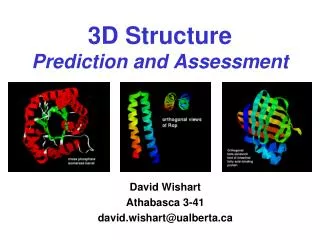
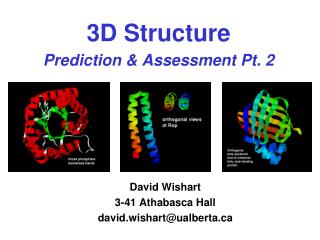
3D StructurePrediction & Assessment Pt. 2 David Wishart 3-41 Athabasca Hall david.wishart@ualberta.ca
Objectives • Become familiar with methods and algorithms for secondary Structure Prediction • Become familiar with protein Threading (2D and 3D threading) • Become acquainted with Ab initio protein structure prediction
3D Structure Generation* • X-ray Crystallography • NMR Spectroscopy • Homology or Comparative Modelling • Secondary Structure Prediction • Threading (2D and 3D threading) • Ab initio Structure Prediction
- - - - Table 10 Secondary (2o)Structure
Secondary Structure Prediction* • One of the first fields to emerge in bioinformatics (~1967) • Grew from a simple observation that certain amino acids or combinations of amino acids seemed to prefer to be in certain secondary structures • Subject of hundreds of papers and dozens of books, many methods…
2o Structure Prediction* • Statistical (Chou-Fasman, GOR) • Homology or Nearest Neighbor (Levin) • Physico-Chemical (Lim, Eisenberg) • Pattern Matching (Cohen, Rooman) • Neural Nets (Qian & Sejnowski, Karplus) • Evolutionary Methods (Barton, Niemann) • Combined Approaches (Rost, Levin, Argos)
Simplified C-F Algorithm* • Select a window of 7 residues • Calculate average Pa over this window and assign that value to the central residue • Repeat the calculation for Pb and Pc • Slide the window down one residue and repeat until sequence is complete • Analyze resulting “plot” and assign secondary structure (H, B, C) for each residue to highest value
Simplified C-F Algorithm helix beta coil 10 20 30 40 50 60
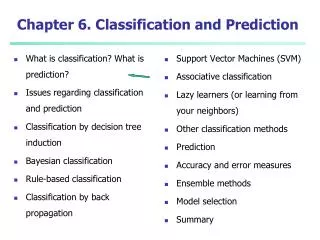
Limitations of Chou-Fasman • Does not take into account long range information (>3 residues away) • Does not take into account sequence content or probable structure class • Assumes simple additive probability (not true in nature) • Does not include related sequences or alignments in prediction process • Only about 55% accurate (on good days)
The PhD Approach PRFILE...
The PhD Algorithm* • Search the SWISS-PROT database and select high scoring homologues • Create a sequence “profile” from the resulting multiple alignment • Include global sequence info in the profile • Input the profile into a trained two-layer neural network to predict the structure and to “clean-up” the prediction
Evaluating Structure 2o Predictions* • Historically problematic due to tester bias (developer trains and tests their own predictions) • Some predictions were up to 10% off • Move to make testing independent and test sets as large as possible • EVA – evaluation of protein secondary structure prediction
EVA • ~10 different methods evaluated in real time as new structures arrive at PDB • Results posted on the web and updated weekly • http://www.pdg.cnb.uam.es/eva/
2o Structure Evaluation* • Q3 score – standard method in evaluating performance, 3 states (H,C,B) evaluated like a multiple choice exam with 3 choices. Same as % correct • SOV (segment overlap score) – more useful measure of how segments overlap and how much overlap exists
Best of the Best • PredictProtein-PHD (74%) • http://www.predictprotein.org/meta.php • Jpred (73-75%) • http://www.compbio.dundee.ac.uk/www-jpred/ • PSIpred (77%) • http://bioinf.cs.ucl.ac.uk/psipred/ • Proteus and Proteus2 (88%) • http://wks80920.ccis.ualberta.ca/proteus/ • http://www.proteus2.ca/proteus2/
Definition* • Threading - A protein fold recognition technique that involves incrementally replacing the sequence of a known protein structure with a query sequence of unknown structure. The new “model” structure is evaluated using a simple heuristic measure of protein fold quality. The process is repeated against all known 3D structures until an optimal fit is found.
Why Threading?* • Secondary structure is more conserved than primary structure • Tertiary structure is more conserved than secondary structure • Therefore very remote relationships can be better detected through 2o or 3o structural homology instead of sequence homology
T H R E A D Visualizing Threading THREADINGSEQNCEECNQESGNI ERHTHREADINGSEQNCETHREAD GSEQNCEQCQESGIDAERTHR...
Visualizing Threading THREADINGSEQNCEECNQESGNI ERHTHREADINGSEQNCETHREAD GSEQNCEQCQESGIDAERTHR... T H R E
Visualizing Threading THREADINGSEQNCEECNQESGNI ERHTHREADINGSEQNCETHREAD GSEQNCEQCQESGIDAERTHR... T H
Visualizing Threading THREADINGSEQNCEECNQESGNI ERHTHREADINGSEQNCETHREAD GSEQNCEQCQESGIDAERTHR...
T H R E A D . . S E Q N C E E C N . . Visualizing Threading
Threading* • Database of 3D structures and sequences • Protein Data Bank (or non-redundant subset) • Query sequence • Sequence < 25% identity to known structures • Alignment protocol • Dynamic programming • Evaluation protocol • Distance-based potential or secondary structure • Ranking protocol
2 Kinds of Threading* • 2D Threading or Prediction Based Methods (PBM) • Predict secondary structure (SS) or ASA of query • Evaluate on basis of SS and/or ASA matches • 3D Threading or Distance Based Methods (DBM) • Create a 3D model of the structure • Evaluate using a distance-based “hydrophobicity” or pseudo-thermodynamic potential
2D Threading Algorithm* • Convert PDB to a database containing sequence, SS and ASA information • Predict the SS and ASA for the query sequence using a “high-end” algorithm • Perform a dynamic programming alignment using the query against the database (include sequence, SS & ASA) • Rank the alignments and select the most probable fold
Database Conversion >Protein1 THREADINGSEQNCEECNQESGNI HHHHHHCCCCEEEEECCCHHHHHH ERHTHREADINGSEQNCETHREAD HHCCEEEEECCCCCHHHHHHHHHH >Protein2 QWETRYEWQEDFSHAECNQESGNI EEEEECCCCHHHHHHHHHHHHHHH YTREWQHGFDSASQWETRA CCCCEEEEECCCEEEEECC >Protein3 LKHGMNSNWEDFSHAECNQESG EEECCEEEECCCEEECCCCCCC
Table 10 Secondary Structure - -
2o Structure Identification* • DSSP - Database of Secondary Structures for Proteins (http://swift.cmbi.ru.nl/gv/start/index.html) • VADAR - Volume Area Dihedral Angle Reporter (http://vadar.wishartlab.com/) • PDB - Protein Data Bank (www.rcsb.org) • STRIDE (http://webclu.bio.wzw.tum.de/cgi-bin/stride/stridecgi.py) QHTAWCLTSEQHTAAVIWDCETPGKQNGAYQEDCA HHHHHHCCEEEEEEEEEEECCHHHHHHHCCCCCCC
Accessible Surface Area Reentrant Surface Accessible Surface Solvent Probe Van der Waals Surface
ASA Calculation* • DSSP - Database of Secondary Structures for Proteins (http://swift.cmbi.ru.nl/gv/start/index.html) • VADAR - Volume Area Dihedral Angle Reporter (http://vadar.wishartlab.com/) • GetArea - http://curie.utmb.edu/getarea.html QHTAWCLTSEQHTAAVIWDCETPGKQNGAYQEDCAMD BBPPBEEEEEPBPBPBPBBPEEEPBPEPEEEEEEEEE 1056298799415251510478941496989999999
Other ASA sites • Connolly Molecular Surface Home Page • http://www.biohedron.com/ • Naccess Home Page • http://www.bioinf.manchester.ac.uk/naccess/ • MSMS • http://www.scripps.edu/~sanner/html/msms_home.html • Surface Racer • http://apps.phar.umich.edu/tsodikovlab/
2D Threading Algorithm • Convert PDB to a database containing sequence, SS and ASA information • Predict the SS and ASA for the query sequence using a “high-end” algorithm • Perform a dynamic programming alignment using the query against the database (include sequence, SS & ASA) • Rank the alignments and select the most probable fold
ASA Prediction* • NetSurfP(70%) • http://www.cbs.dtu.dk/services/NetSurfP/ • PredAcc (70%?) • http://mobyle.rpbs.univ-paris-diderot.fr/cgi-bin/portal.py?form=PredAcc QHTAW... QHTAWCLTSEQHTAAVIW BBPPBEEEEEPBPBPBPB
2D Threading Algorithm • Convert PDB to a database containing sequence, SS and ASA information • Predict the SS and ASA for the query sequence using a “high-end” algorithm • Perform a dynamic programming alignment using the query against the database (include sequence, SS & ASA) • Rank the alignments and select the most probable fold
G E N E T I C S G 10 0 0 0 0 0 0 0 E 0 10 0 10 0 0 0 0 N 0 0 10 0 0 0 0 0 E 0 0 0 10 0 10 0 0 S 0 0 0 0 0 0 0 10 I 0 0 0 0 0 10 0 0 S 0 0 0 0 0 0 0 10 Dynamic Programming G E N E T I C S G 60 40 30 20 20 0 10 0 E 40 50 30 30 20 0 10 0 N 30 30 40 20 20 0 10 0 E 20 20 20 30 20 10 10 0 S 20 20 20 20 20 0 10 10 I 10 10 10 10 10 20 10 0 S 0 0 0 0 0 0 0 10
Sij(Identity Matrix) A C D E F G H I K L M N P Q R S T V W Y A1 0 0 0 0 0 0 0 0 0 0 0 0 0 0 0 0 0 0 0 C 0 1 0 0 0 0 0 0 0 0 0 0 0 0 0 0 0 0 0 0 D 0 0 1 0 0 0 0 0 0 0 0 0 0 0 0 0 0 0 0 0 E 0 0 0 1 0 0 0 0 0 0 0 0 0 0 0 0 0 0 0 0 F 0 0 0 0 1 0 0 0 0 0 0 0 0 0 0 0 0 0 0 0 G 0 0 0 0 0 1 0 0 0 0 0 0 0 0 0 0 0 0 0 0 H 0 0 0 0 0 0 1 0 0 0 0 0 0 0 0 0 0 0 0 0 I 0 0 0 0 0 0 0 1 0 0 0 0 0 0 0 0 0 0 0 0 K 0 0 0 0 0 0 0 0 1 0 0 0 0 0 0 0 0 0 0 0 L 0 0 0 0 0 0 0 0 0 1 0 0 0 0 0 0 0 0 0 0 M 0 0 0 0 0 0 0 0 0 0 1 0 0 0 0 0 0 0 0 0 N 0 0 0 0 0 0 0 0 0 0 0 1 0 0 0 0 0 0 0 0 P 0 0 0 0 0 0 0 0 0 0 0 0 1 0 0 0 0 0 0 0 Q 0 0 0 0 0 0 0 0 0 0 0 0 0 1 0 0 0 0 0 0 R 0 0 0 0 0 0 0 0 0 0 0 0 0 0 1 0 0 0 0 0 S 0 0 0 0 0 0 0 0 0 0 0 0 0 0 0 1 0 0 0 0 T 0 0 0 0 0 0 0 0 0 0 0 0 0 0 0 0 1 0 0 0 V 0 0 0 0 0 0 0 0 0 0 0 0 0 0 0 0 0 1 0 0 W 0 0 0 0 0 0 0 0 0 0 0 0 0 0 0 0 0 0 1 0 Y 0 0 0 0 0 0 0 0 0 0 0 0 0 0 0 0 0 0 0 1
A Simple Example...* A A T V D A 1 V V D A A T V D A 1 1 V V D A A T V D A 1 1 0 0 0 V V D A A T V D A 1 1 0 0 0 V 0 V D A A T V D A 1 1 0 0 0 V 0 1 1 V D A A T V D A 1 1 0 0 0 V 0 1 1 2 V D
A Simple Example..*. A A T V D A 1 1 0 0 0 V 0 1 1 2 1 V D A A T V D A 1 1 0 0 0 V 0 1 1 2 1 V 0 1 1 2 2 D 0 1 1 1 3 A A T V D A 1 1 0 0 0 V 0 1 1 2 1 V 0 1 1 2 2 D 0 1 1 1 3 A A T V D | | | | A - V V D A A T V D | | | | A V V D A A T V D | | | | A V - V D