
SlideServe
Menu
Préférences
© SlideServe · v2026

Capacity Allocation for New Firm Transportation Request in Gas Shipper Network

palmer-luna avatar
2 diapositives · 162 Views · Nov 17, 2014

This document outlines the methodology for reallocating capacity among existing shippers to accommodate a new firm transportation request by Shipper C for 50 MDth/d. The analysis focuses on existing Maximum Delivery Obligations (MDO) and Contractual Minimum Quantities (CMQ) of Shipper A and Shipper B. It calculates excess MDO, determines available capacity after the new request, and allocates the remaining MDO based on pro-rata CMQ to ensure compliance with the overall lateral capacity constraints.
Capacity Allocation for New Firm Transportation Request in Gas Shipper Network - slide 1
01 / 2Capacity Allocation for New Firm Transportation Request in Gas Shipper Network
1 / 17

Télécharger la présentation

Capacity Allocation for New Firm Transportation Request in Gas Shipper Network
Une image / un lien ci-dessous est fourni (tel quel) pour télécharger la présentation

Politique de téléchargement : le contenu du site vous est fourni TEL QUEL pour votre information et votre usage personnel ; il ne peut être vendu, concédé sous licence ni partagé sur d’autres sites sans l’accord de son auteur.Le contenu vous est fourni TEL QUEL, pour votre information et votre usage personnel uniquement. Téléchargez la présentation en cliquant sur ce lien. Lors du téléchargement, si vous ne parvenez pas à télécharger une présentation, l’éditeur a peut-être supprimé le fichier de son serveur.Pendant le téléchargement, si vous ne parvenez pas à obtenir une présentation, le fichier a peut-être été supprimé par l’éditeur.

F I N

Plus de contenu associé

Transcription de la présentation
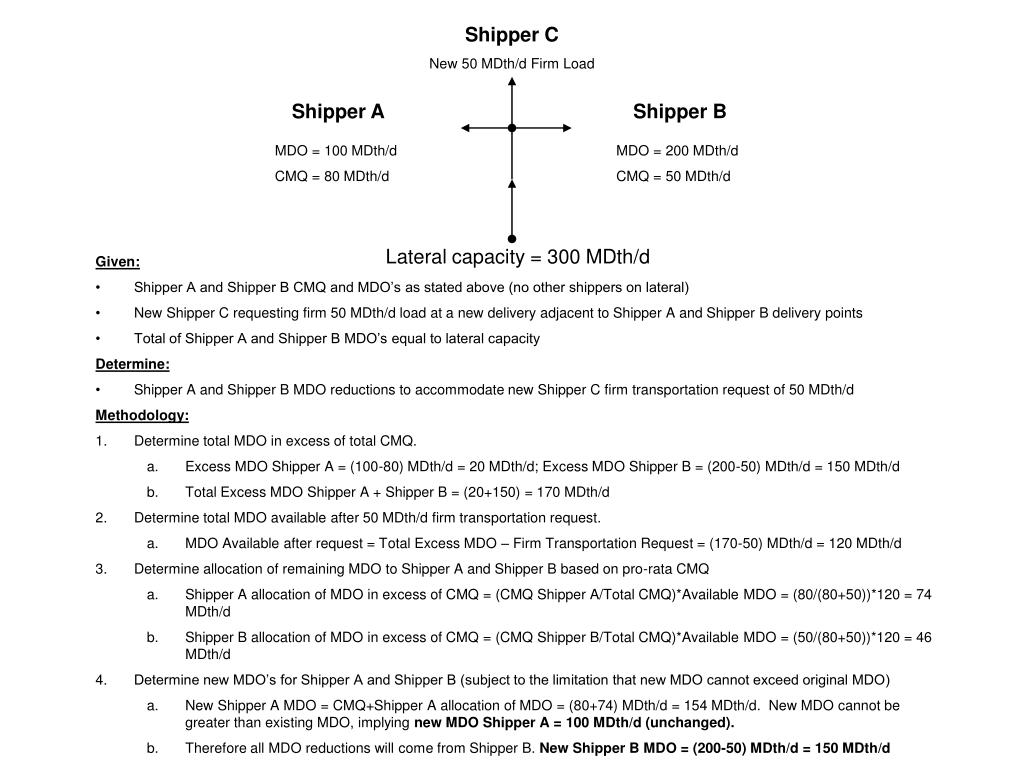
  1. Shipper C New 50 MDth/d Firm Load Shipper A Shipper B MDO = 100 MDth/d CMQ = 80 MDth/d MDO = 200 MDth/d CMQ = 50 MDth/d Lateral capacity = 300 MDth/d • Given: • Shipper A and Shipper B CMQ and MDO’s as stated above (no other shippers on lateral) • New Shipper C requesting firm 50 MDth/d load at a new delivery adjacent to Shipper A and Shipper B delivery points • Total of Shipper A and Shipper B MDO’s equal to lateral capacity • Determine: • Shipper A and Shipper B MDO reductions to accommodate new Shipper C firm transportation request of 50 MDth/d • Methodology: • Determine total MDO in excess of total CMQ. • Excess MDO Shipper A = (100-80) MDth/d = 20 MDth/d; Excess MDO Shipper B = (200-50) MDth/d = 150 MDth/d • Total Excess MDO Shipper A + Shipper B = (20+150) = 170 MDth/d • Determine total MDO available after 50 MDth/d firm transportation request. • MDO Available after request = Total Excess MDO – Firm Transportation Request = (170-50) MDth/d = 120 MDth/d • Determine allocation of remaining MDO to Shipper A and Shipper B based on pro-rata CMQ • Shipper A allocation of MDO in excess of CMQ = (CMQ Shipper A/Total CMQ)*Available MDO = (80/(80+50))*120 = 74 MDth/d • Shipper B allocation of MDO in excess of CMQ = (CMQ Shipper B/Total CMQ)*Available MDO = (50/(80+50))*120 = 46 MDth/d • Determine new MDO’s for Shipper A and Shipper B (subject to the limitation that new MDO cannot exceed original MDO) • New Shipper A MDO = CMQ+Shipper A allocation of MDO = (80+74) MDth/d = 154 MDth/d. New MDO cannot be greater than existing MDO, implying new MDO Shipper A = 100 MDth/d (unchanged). • Therefore all MDO reductions will come from Shipper B. NewShipper B MDO = (200-50) MDth/d = 150 MDth/d

  2. Shipper C New 50 MDth/d Firm Load Shipper A Shipper B MDO = 100 MDth/d CMQ = 80 MDth/d MDO = 200 MDth/d CMQ = 150 MDth/d Lateral capacity = 300 MDth/d • Given: • Shipper A and Shipper B CMQ and MDO’s as stated above (no other shippers on lateral) • New Shipper C requesting firm 50 MDth/d load at a new delivery adjacent to Shipper A and Shipper B delivery points • Total of Shipper A and Shipper B MDO’s equal to lateral capacity • Determine: • Shipper A and Shipper B MDO reductions to accommodate new Shipper C firm transportation request of 50 MDth/d • Methodology: • Determine total MDO in excess of total CMQ. • Excess MDO Shipper A = (100-80) MDth/d = 20 MDth/d; Excess MDO Shipper B = (200-150) MDth/d = 50 MDth/d • Total Excess MDO Shipper A + Shipper B = (20+50) = 70 MDth/d • Determine total MDO available after 50 MDth/d firm transportation request. • MDO Available after request = Total Excess MDO – Firm Transportation Request = (70-50) MDth/d = 20 MDth/d • Determine allocation of remaining MDO to Shipper A and Shipper B based on pro-rata CMQ • Shipper A allocation of MDO in excess of CMQ = (CMQ Shipper A/Total CMQ)*Available MDO = (80/(80+150))*20 = 7 MDth/d • Shipper B allocation of MDO in excess of CMQ = (CMQ Shipper B/Total CMQ)*Available MDO = (150/(80+150))*20 = 13 MDth/d • Determine new MDO’s for Shipper A and Shipper B • New Shipper A MDO = CMQ+Shipper A allocation of MDO = (80+7) MDth/d = 87 MDth/d. • NewShipper B MDO = CMQ+Shipper B allocation of MDO = (150+13) MDth/d = 163 MDth/d