Engineering Acceleration Problems Solved Effectively
Explore methods to determine velocity and acceleration in rotating bodies with fixed axes or general plane motion, solving complex engineering problems accurately.

Engineering Acceleration Problems Solved Effectively
E N D
Presentation Transcript
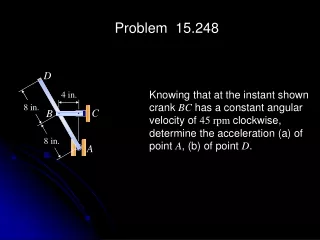
D 4 in. 8 in. C B 8 in. A Problem 15.248 Knowing that at the instant shown crank BC has a constant angular velocity of 45 rpm clockwise, determine the acceleration (a) of point A, (b) of point D.
Problem 15.248 D 4 in. 8 in. C B 8 in. A v = rw y r x w Solving Problems on Your Own Knowing that at the instant shown crank BC has a constant angular velocity of 45 rpm clockwise, determine the acceleration (a) of point A, (b) of point D. 1. Determine velocities in a body rotating about a fixed axis: In vector form the velocity in the body is given by: v = wxr Where v , w , and r are the velocity of the point, the angular velocity of the body, and the position vector from the axis to the point. The magnitude of the velocity is given by: v = rw where v,r, and w are the magnitudes of the corresponding vectors.
Problem 15.248 D 4 in. 8 in. C B 8 in. A w A rB/A + vB/A B Solving Problems on Your Own Knowing that at the instant shown crank BC has a constant angular velocity of 45 rpm clockwise, determine the acceleration (a) of point A, (b) of point D. 2. Determine velocities in a body under general plane motion: Velocities can be determined either by method of instantaneous center of rotation, or by considering the motion of the body as the sum of a translation and a rotation. C vA vA vB A A vA = vB B B B A vA vB = vA + vB/AvB/A = wxrB/A
Problem 15.248 D 4 in. 8 in. C B 8 in. A Solving Problems on Your Own Knowing that at the instant shown crank BC has a constant angular velocity of 45 rpm clockwise, determine the acceleration (a) of point A, (b) of point D. 3. Determine the acceleration in a body rotating about a fixed axis: In vector form the acceleration is given by: a = axr + wx ( wxr ) The normal and tangential components are given by: an = rw2at = ra where w and a are the angular velocity and angular acceleration, respectively. at = ra y w an = rw2 x a
Problem 15.248 D 4 in. 8 in. C B 8 in. A y’ wk A x’ ak aB/A (aB/A)n (aB/A)t B (c) Solving Problems on Your Own Knowing that at the instant shown crank BC has a constant angular velocity of 45 rpm clockwise, determine the acceleration (a) of point A, (b) of point D. 4. Determine accelerations in a body under general plane motion: Draw (a) a plane motion diagram, (b) translation diagram, and (c) rotation diagram. A A aA aA + = B B aA aB (a) (b) aB = aA + aB/AoraB = aA + (aB/A )n + (aB/A )t
Problem 15.248 Solution D 4 in. 8 in. C B rad min 2 p 8 in. wBC = (45 rpm)( ) = 1.5p rad/s A s rev 60 D vB B vA A Determine velocities in a body rotating about a fixed axis. Calculating the velocity of point B in crank BC. vB = wBC rB/C = (1.5p rad/s)(4 in) = 18.85 in/s vB = 18.85 in/s vB wBC C Determine velocities in a body under general plane motion. B Since point A is forced to move in the vertical direction, and the direction of the velocity of point B is up, the angular velocity of bar AD is zero: wAD = 0
Problem 15.248 Solution D 4 in. 8 in. C B 8 in. A (aB)n = (wBC )2 rB/C = (1.5p rad/s)2 (4 in) (aB)n = 88.83 rad/s 2 Determine accelerations in a body rotating about a fixed axis. Calculating the acceleration of point B in crank BC. Since the angular velocity of crank BC is constant, aBC= 0 and (aB)t = 0. The normal component of the acceleration at point B is: wBC (aB)n C B aBC = 0
Problem 15.248 Solution D 4 in. 8 in. C B 8 in. A aADis assumed CCW D 30o (aD/B)t B + aAD (aA/B)t 30o A Determine accelerations in a body under general plane motion. (aD)y (aD)x aB D D = aB aB B B aA aB A A The acceleration aA must be vertical
Acceleration of point A: Problem 15.248 Solution + xcomponent: + y component: D D D aB aB aAD B + = B B (aA/B)t aA 30o aB A A A aA = aB + (aA/B)t [aA ] = [88.83 ] + [ 8 aAD 30o ] Equating the x and y components: 0 = 88.82 + 8 aAD cos 30o aAD = - 12.82 rad/s2 (aADis actually CW) aA = 0 + 8 (- 12.82)sin 30o aA = - 51.3 in/s2aA = 51.3 in/s2
Acceleration of point D: Problem 15.248 Solution 30o (aD/B)t aD = aB + (aD/B)t [(aD)x ] + [(aD)y ] = [88.83 ] + [ 8 aDA 30o ] + x component: (aD)y = 0 - ( 8 )(- 12.82 ) sin 30o (aD)y = 51.3 in/s2aD = 184.9 in/s2 16.1o + y component: (aD)y aB D (aD)x D D aB aB aAD B + = B B A A A Equating the x and y components: (aD)x = 88.82 - ( 8 )(- 12.82 ) cos 30o (aD)x = 177.7 in/s2