Ancient Learning: The Evolution of Education from Babylon to Medieval Universities
Explore the rich history of ancient learning, from the Babylonian scribes and early Egyptian literacy to the influential Greek philosophers such as Socrates, Plato, and Aristotle. Discover how education evolved through the ages, including the establishment of royal courts and cathedral schools, the emergence of universities, and the challenges faced during the Dark Ages. This journey reveals the transformation of teaching methods, the role of women in education, and the gradual shift in educational authority leading to the foundations of modern academic institutions.

Ancient Learning: The Evolution of Education from Babylon to Medieval Universities
E N D
Presentation Transcript
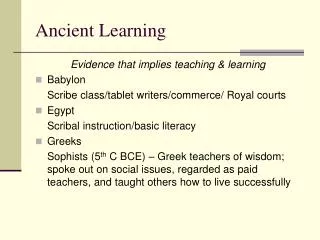
Ancient Learning Evidence that implies teaching & learning • Babylon Scribe class/tablet writers/commerce/ Royal courts • Egypt Scribal instruction/basic literacy • Greeks Sophists (5th C BCE) – Greek teachers of wisdom; spoke out on social issues, regarded as paid teachers, and taught others how to live successfully
Ancient Learning The “Greats” • Socrates (469—399 BCE) Dialectic to define essence of anything Instruction does not require buildings—marketplace. Plato created an academy outside of Athens (335 BCE – 529 AD) Plato studied w/Socrates and Aristotle studied w/Plato. Additional schools of philosophy in Greece • Alexandria Museum, 300 BCE Collecting place for manuscripts, attracts scholars, research center, library holding 120,000 single books • Similar Centers Mark Anthony, Julius Caesar, Asia Minor
Ancient Learning • Learning supported by Royal Court w/o much interference • Christian Rome replaces Greek as center of learning • Emergence of licensing of schools, allocation of space for schools • 8th C AD Church controls education to Dark Ages • 11th C Europe begins to emerge from Dark Ages • Trade, commerce, formation of guilds • Pope Gregory VII supports cathedral schools to educate clergy
Ancient Learning Women in Education • Education reserved for males • Some mention of learned nuns and women teachers of the young • Apostle Paul stated “A woman must be a learner, listening quietly and with due submission. But I suffer not a woman to be a teacher, nor should a woman be allowed to usurp a man’s authority, but must remain silent.”
Ancient Learning Women in Education cont. • Aristotle: woman was defective male • Role: Marriage and children or convent • Some exceptions: Dorotea Bocci 1390 philosophy/Bologna
Ancient Learning Early Medieval (7th -12th C in Europe) • Obstacles to Education: • Church main educator • Universities suppose to search for Classical and Christian thought • Political situation • Lack of interest • Thought of as Vocational Institutions • Open Access • Lack of physical equipment
Ancient Learning • Pre-1500 era • Universities provided little social status • 11th and 12 centuries • Universities went from Monasteries to Cathedral schools • Academic Life: Theology & Law (Canon) • Subjects taught: The Seven Liberal Arts Trivium: grammar, rhetoric, and dialect Quadtrivium: arithmetic, geometry, astronomy, music 12th C. Philosophy included
Ancient Learning 12th Century Europe • 4 Stages in the Development of the Medieval University • Written laws – 1210 Paris reference to a written document • Right to be sued – 1212 University of Paris sued in Papal Court by local religious authority • Official seal – proof of existence of funds to pay debts (Dartmouth case) • Approval to collect money and engage in transactions – 1215 Pope gives Univ. of Paris authority to make its own rules etc.
Ancient Learning • Chancellor: • Paris – had restrictive authority • England – Broaden authority (spiritual, civil, criminal jurisdiction) • Students • Teachers • Townspeople • University/Town relationship • Murder • Tavern Fights • Hostile Mayors
Ancient Learning • Prerequisites for becoming a student Latin, read, write, speak, typical age: 14; course of study: 5 years • Letter of Recommendation • Poor Scholars
Ancient Learning Student schedule-Bologna 1517 Rise – 4 am Arts Lecture – 5 am Mass & Breakfast – 6 am Classes – 8 to 10 am Formal debates before noon meal Repetitions (questions about lectures) Lectures – 3to 5 pm Disputations (explanation of a statement or theory) – 5 to 6 pm Repetitions – after evening meal (beer was common) Bed – 9 pm • Fines (gambling, handball, swordplay, animals, prostitution) **Only Latin spoken in the Halls** ***No weapons*** • Punishment: deprivation of commons or meals (Flogging?)
Ancient Learning Course of Study • Baccalaureate 5 years Determination – exam given by a faculty member and open to the public during lent • Master’s Additional study Proscribed readings/disputations/permission to teach, pass an exam • PhD 1366 theology 16 years beyond master’s 35 years old
Ancient Learning Oxford & Cambridge The roots of US Higher Education • Oxford Full university towards the close of the 12th C Specialized: Arts, civil and canon law, theology, medicine (added 13th C) • Cambridge Specialized: Arts, canon law, theology, civil law, medicine (later time) 14th C students: at least 14 years, average age 15-17, undergraduate curriculum-classical