Understanding Digestion: Key Concepts in Nutrition and Metabolism
Dive into the essentials of human digestion, metabolism, and urinary functions. Explore the four layers of the gastrointestinal tract—mucosa, submucosa, muscularis, and adventitia—and understand the role of the greater omentum. Learn where starch digestion begins, the significance of the pulp cavity in teeth, and the hormones that regulate gluconeogenesis. Discover the nephron's structure, glomerulus' function, and the importance of enzymes like renin. This comprehensive guide covers critical concepts that bridge nutrition, digestion, and kidney function.

Understanding Digestion: Key Concepts in Nutrition and Metabolism
E N D
Presentation Transcript
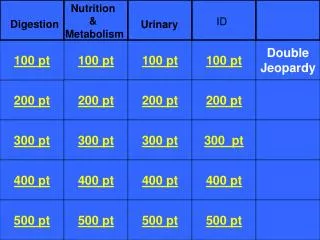
Nutrition & Metabolism ID Digestion Urinary 100 pt 100 pt 100 pt 100 pt Double Jeopardy 200 pt 200 pt 200 pt 200 pt 300 pt 300 pt 300 pt 300 pt 400 pt 400 pt 400 pt 400 pt 500 pt 500 pt 500 pt 500 pt
What are • Mucosa • Submucosa • Muscularis • Adventia (serosa)?
A double layer of fat that drapes over the small and large intestine
The location where chemical digestion of starch first begins?
The space inside a tooth that contains connective tissue, blood vessels, nerves and lymphatic vessels
In aerobic respiration 2 of these molecules enter into the Krebs cycle
In the electron transport chain, ATP production is coupled with the pumping of H+ ions
Nutrient molecules that can be oxidized to produce ATP or stored in adipose tissue
A hormone secreted by adipocytes that act to decrease total body fat mass
Pores in the glomerular endothilial cells that allow filtration of blood solutes, but not blood cells and platelets
Double Jeopardy ACh, gastrin, histamine and sight, thought or smell of food stimulates the secretion of this chemical substance from the parietal cells