Voter Rationality
Voter Rationality. Oana Carja Daniel Kluesing Sang Won Lee. a rational individual will not vote. Economically, reward for voting is small. There is almost no chance that one voter will swing the entire election. Using probability model we will show Irrational behavior of voters

Voter Rationality
E N D
Presentation Transcript
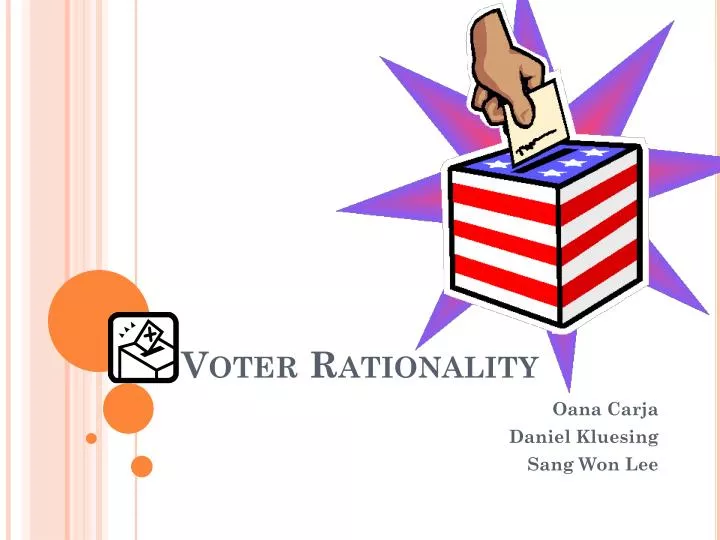
Voter Rationality Oana Carja Daniel Kluesing Sang Won Lee
a rational individual will not vote • Economically, reward for voting is small. • There is almost no chance that one voter will swing the entire election. • Using probability model we will show • Irrational behavior of voters • Probability that my vote is decisive • Relation of turnout and swing state
Expected Utility of voting • Assumption • People will vote only when they expect payoff greater than the payoff of not voting. • Variables • Gain : What you get when your candidate wins election. • Loss: Time/Effort spent on voting • p : P(My Candidate wins | I go to vote) • q : P(My Candidate wins | I don’t go to vote)
Expected Utility of voting Expected Utility • Given that I go to vote. • Given that I don’t go to vote • To vote, one should expect more. p(Gain – Loss ) + (1-p)( – Loss) ≥ q(Gain) (p-q) Gain ≥ Loss p My Candidate Win (Gain – Loss) p(Gain – Loss ) + (1-p) ( – Loss) My Candidate Lose ( – Loss) 1-p ≥ q My Candidate Win (Gain) q(Gain) My Candidate Lose (0) 1-q
Ex) an individual in a swing state, Missouri • Assumption • Poll Result on Nov. 3rd will be the actual fraction of voters. • Undecided voter works as independent 50-50 coin flip. • The target voter supports for Obama. • In this situation, Obama need to get 43,203 from undecided voter to make tie. The number of undecided voter who actually voted for Obama, denoted X, follows B(73139, 0.5) • By central limit theorem, normal approximation is used. B(73139,0.5) ≈ N( 36569.5 , 135.22)
Ex) an individual in a swing state, Missouri • p : P(Obama wins | I go to vote) = P( at least tie without my vote) = P( X ≥ 43,023 ) • q : P(Obama wins | I don’ go to vote) = P( Obama win without my vote) = P (X ≥ 43,204 ) • With normal approximation, P( X ≥ 43,023 ) = 0 P( X ≥ 43,024 ) = 0 • In the original equation, (p-q) Gain ≥ Loss since (p-q) is ZERO, LHS of the equation is zero regardless of personal gain. • It’s irrational to go to vote, even in the swing state like Missouri.
Probability of Casting the Decisive Vote • The probability of having a decisive vote in the election equals the probability that your state is necessary for an Electoral College win, times the probability that your vote is decisive in your home-state P(decisive vote in the entire election) = P(your home state is decisive ) × P(your vote is decisive in your home state) • P( the state is decisive) • The probability that your home-state’s electoral votes are necessary for your candidate winning is: • P(|Oev - Mev|<E) +1/2P((|Oev - Mev|=E) • (P for some states are shown in the table.)
Probability of Casting the Decisive Vote • P(your vote is decisive in your home state) = P(tie in your home state | you do not vote) • Two method in calculation of P(tie). (CASE 1) Binomial distribution for undecided voters, with a free parameter p of voting for Obama (CASE 2) Binomial distribution for all voters, with parameter equal to the fraction of Obama voters • Even with a relatively small election of 1000 voters, the probability of casting a decisive vote is small.
Probability of Casting the Decisive Vote • P(your vote is decisive vote in the entire election) • Combining previous two probability • Even for a voter in a swing state like Florida, probability of casting a decisive vote on the national scale is essentially zero for any reasonable national election. Even in close elections like in 2000
Implications for turnout • From the equation, a voter turn out when (p-q) Gain ≥ Loss • (p-q) represents “How much my vote matters?” • My vote matters more in swing states than safe states. Equation says an individual in swing states more likely to go to vote than one in the safe states. • In the 2008 presidential election, the safer the state was, the less people turn out to vote. It showed negative dependence. • ρ(X,Y) = - 0.25 (2008 U.S. Presidential Election Data)
Summary and Conclusion • A rational voter should not turn out to vote as their expected reward is negligible • One voter cannot swing the election even in the swing states. • Those who lives in swing states are more likely to turn out. • Require other method to explain voter behavior • Considering civic duty, a sense of patriotism • Finding Equilibrium – If no one turn out because it’s irrational, I have chance to swing the election.