SlideServe
Menu
Préférences
© SlideServe · v2026

Comprehensive Guide to Making Copper Sulfate Through Acid-Base Reactions

patia avatar
9 diapositives · 262 Views · Aug 28, 2014

This instructional guide details the process of making copper sulfate through a series of chemical reactions involving acids and metal carbonates. It includes word equations for reactions like acid plus alkali, and acid plus metal, guiding students to complete these equations. The document discusses the test for hydrogen gas, known as the squeaky pop test, and outlines the step-by-step procedure for producing copper sulfate using sulfuric acid and copper carbonate. Additionally, it offers balanced equations and encourages further exploration with other metal carbonates.
Comprehensive Guide to Making Copper Sulfate Through Acid-Base Reactions - slide 1
01 / 9Comprehensive Guide to Making Copper Sulfate Through Acid-Base Reactions
1 / 17

Télécharger la présentation

Comprehensive Guide to Making Copper Sulfate Through Acid-Base Reactions
Une image / un lien ci-dessous est fourni (tel quel) pour télécharger la présentation

Politique de téléchargement : le contenu du site vous est fourni TEL QUEL pour votre information et votre usage personnel ; il ne peut être vendu, concédé sous licence ni partagé sur d’autres sites sans l’accord de son auteur.Le contenu vous est fourni TEL QUEL, pour votre information et votre usage personnel uniquement. Téléchargez la présentation en cliquant sur ce lien. Lors du téléchargement, si vous ne parvenez pas à télécharger une présentation, l’éditeur a peut-être supprimé le fichier de son serveur.Pendant le téléchargement, si vous ne parvenez pas à obtenir une présentation, le fichier a peut-être été supprimé par l’éditeur.

F I N

Plus de contenu associé

Transcription de la présentation
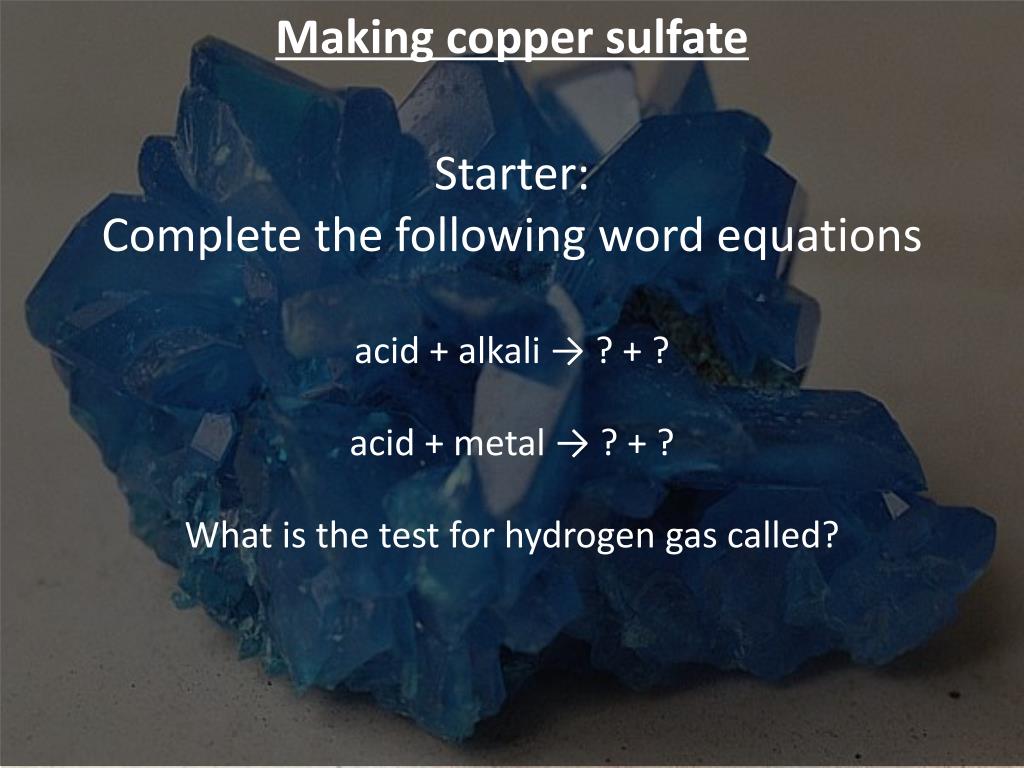
  1. Making copper sulfate Starter: Complete the following word equations acid + alkali → ? + ? acid + metal → ? + ? What is the test for hydrogen gas called?

  2. Making copper sulfate Starter: Complete the following word equations acid + alkali → salt + water acid + metal → salt + hydrogen What is the test for hydrogen gas called? The squeaky pop test

  3. Making copper sulfate Starter: Complete the following word equations magnesium + hydrochloric acid → ? + ? magnesium + ? → magnesium nitrate + ? ? + ? → magnesium sulfate + hydrogen

  4. Making copper sulfate Starter: Complete the following word equations magnesium + hydrochloric acid → magnesium chloride + hydrogen magnesium + nitric acid → magnesium nitrate + hydrogen magnesium + sulfuric acid → magnesium sulfate + hydrogen

  5. Making copper sulfate 1 Put 20 ml of sulfuric acid into a beaker. 2 Add a spatula of copper carbonate, stir it gently using a glass rod and look for bubbles. 3 When the reaction stops, repeat step 2. 4 Stop adding copper carbonate when no further bubbles form. 5 Filter the solution, carefully collecting the copper sulfate solution you have made in an evaporating dish. 6 Heat your solution gently over awater bath, stop when you see blue crystals forming.

  6. To record Copper sulfate is also a salt, but this time we used a new chemical, copper carbonate, to provide the copper. When a metal carbonate reacts you get three products that are formed: metal carbonate + acid → salt + water + carbon dioxide (crystals) (evaporated) (bubbles)

  7. To consolidate In our case we reacted copper carbonate with sulfuric acid: copper carbonate + sulfuric acid → copper sulfate + water + carbon dioxide 8B6 2 and 3 will help you to practise writing word equations for this new reaction.

  8. Extend your chemistry Copper carbonate has the formula CuCO3 Sulfuric acid has the formula H2SO4 The balanced symbol equation for this reaction is: CuCO3 + H2SO4 → CuSO4 + H2O + CO2 See if you can write the balanced symbol equation for other metal carbonates such as CaCO3, SrCO3, BaCO3 and FeCO3. Don't forget to name the salt.

  9. Extend your chemistry CaCO3 + H2SO4 → CaSO4 + H2O + CO2 SrCO3 + H2SO4 → SrSO4 + H2O + CO2 BaCO3 + H2SO4 → BaSO4 + H2O + CO2 FeCO3 + H2SO4 → FeSO4 + H2O + CO2