Diffusion and Osmosis in Passive Transport
70 likes | 95 Vues
Explore how materials move across membranes due to concentration differences. Learn about diffusion and osmosis, passive transport types, and factors affecting diffusion rate like temperature and solute concentration.


Diffusion and Osmosis in Passive Transport
E N D
Presentation Transcript
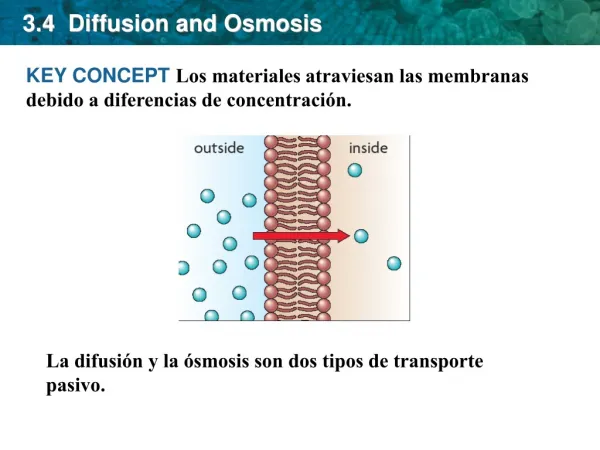
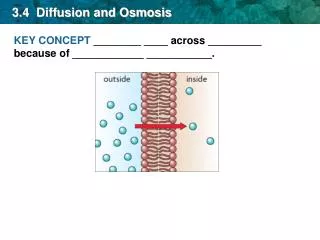
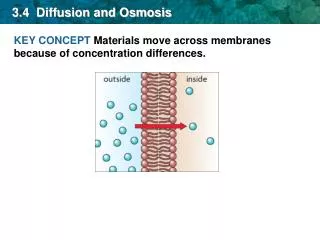
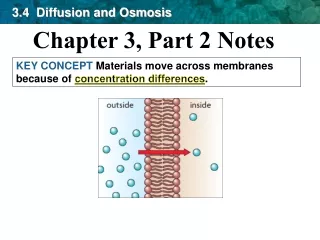
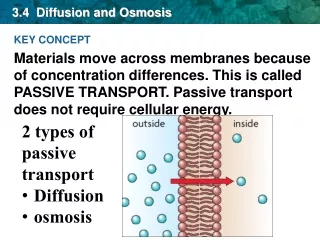
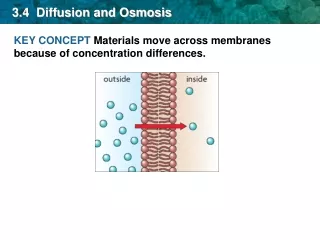
3.4 Diffusion and Osmosis • KEY CONCEPT Materials move across membranes because of concentration differences.
3.4 Diffusion and Osmosis • Passive transport does not require energy input from a cell. • Molecules can move across the cell membrane through passive transport. • There are two types of passive transport. • diffusion • osmosis
3.4 Diffusion and Osmosis • Diffusion and osmosis are types of passive transport. • Molecules diffuse down a concentration gradient.
3.4 Diffusion and Osmosis • Diffusion and osmosis are types of passive transport. • Osmosis is the diffusion of water molecules across a semipermeable membrane.
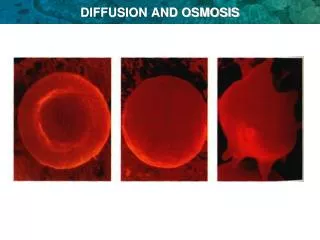
3.4 Diffusion and Osmosis • Diffusion and osmosis are types of passive transport. • There are three types of solutions. • isotonic • hypertonic • hypotonic
3.4 Diffusion and Osmosis • Some molecules can only diffuse through transport proteins. • Some molecules cannot easily diffuse across the cell membrane. • Facilitated diffusion is diffusion through transport proteins.
Factors that affect rate of diffusion? • Take some time to think about various factors that could affect the rate of diffusion. • Temperature • Particle Size • pH • Solute concentration