
Insights into Aging: Evolutionary Theories and Genetic Factors
E N D
Presentation Transcript
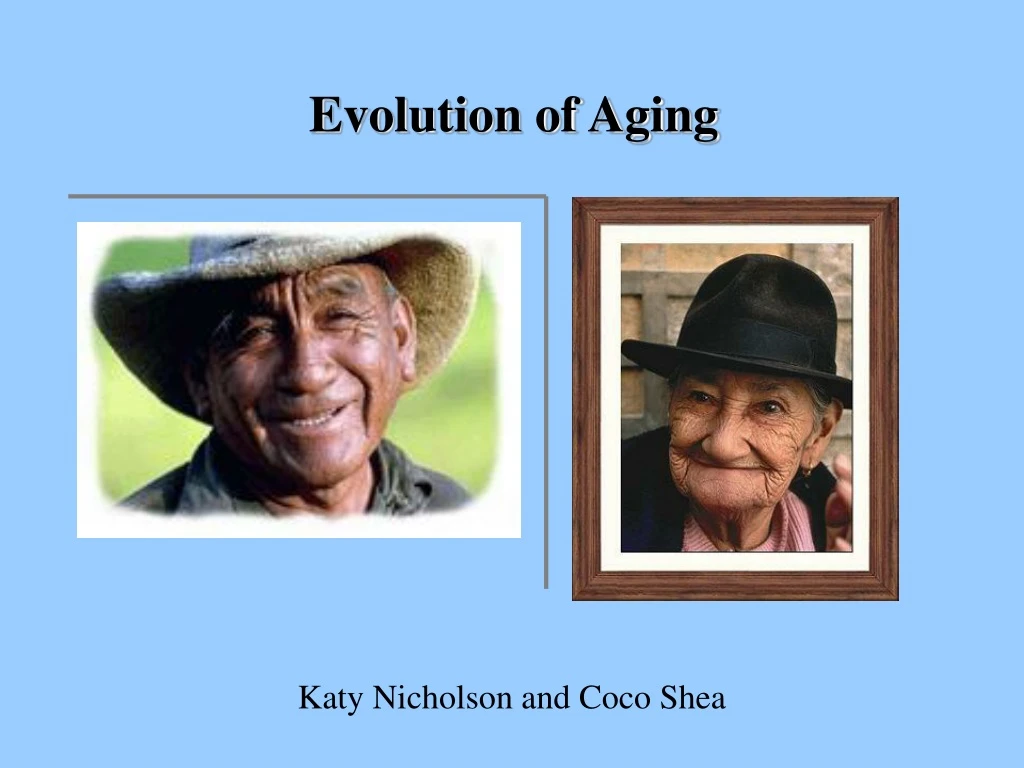
Evolution of Aging Katy Nicholson and Coco Shea
Decline in individual’s fertility and probability • of survival • Lose ability to completely repair mutations in • cells and tissue (lack of energy) Definition of Aging (Senescence) • Decline in individual’s fertility and probability • of survival • Lose ability to completely repair mutations in • cells and tissue (lack of energy) • Decline in individual’s fertility and probability • of survival • Decline in individual’s fertility and probability • of survival
Populations lack the genetic variation necessary to respond to selection against aging • Telomeres are shortened every time a cell divides (Harley et al. 1990) Rate of Living Theory • Populations lack the genetic variation necessary to respond to selection against aging • Populations lack the genetic variation necessary to respond to selection against aging • Telomeres are shortened every time a cell divides (Harley et al. 1990)
Accumulation of deleterious mutations after reproductive age • Accumulation of deleterious mutations after reproductive age • Less selective pressure on deleterious mutations after reproductive age • Less selective pressure on deleterious mutations after reproductive age • Neutral alleles can drift to fixation Evolutionary Theory of Aging • Accumulation of deleterious mutations after reproductive age • Accumulation of deleterious mutations after reproductive age • Less selective pressure on deleterious mutations after reproductive age • Neutral alleles can drift to fixation
Evolution of Shorter Life Span: Accumulation of Deleterious Mutations Fig. 12.11Houseflies - Reed and Bryant (2000)
Reproduce Early or Reproduce Longer? • Antagonistic Pleiotropy Hypothesis – Mutation • allocates energy to early reproduction or late death Energy Trade-Offs • Reproduce Early or Reproduce Longer? • Reproduce Early or Reproduce Longer? • Antagonistic Pleiotropy Hypothesis – Mutation • allocates energy to early reproduction or late death
Antagonistic Pleiotropy Hypothesis • eg. Nematode: Caenorhabditis elgans (Walker et al. 2000) • eg. Nematode: Caenorhabditis elgans (Walker et al. 2000) Fig. 12.12
Aging is accumulation of deleterious • mutations • Allocate energy to reproducing early or to • repairing cells later Conclusion • Aging is accumulation of deleterious • mutations • Aging is accumulation of deleterious • mutations • Allocate energy to reproducing early or to • repairing cells later