Development of an Open Source Multi-Process 3D Printer for Enhanced Prototyping
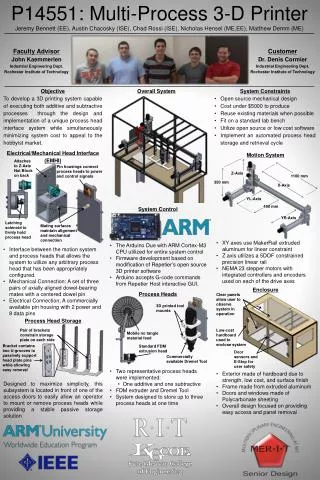
The project focuses on creating a prototype for an open-source multi-process 3D printer, aimed at addressing the limitations of expensive proprietary machines. By demonstrating innovative capabilities on a budget under $5,000, the team seeks to develop an extensible design for hobbyists and stakeholders in the 3D printing community. Following structured engineering requirements, the project will deliver both functional prototypes and extensive documentation, paving the way for future advancements in multi-process printing technology.

Development of an Open Source Multi-Process 3D Printer for Enhanced Prototyping
E N D
Presentation Transcript
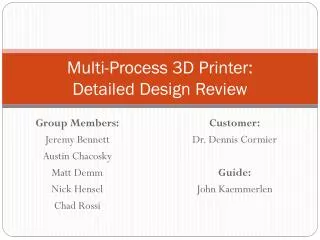
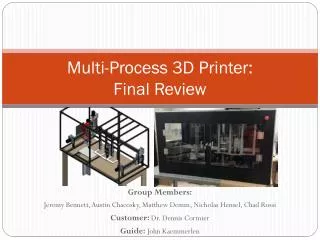
P14551: Multi-Process 3-D Printer Group Members: Jeremy Bennett Austin Chacosky Matt Demm Nick Hensel Chad Rossi Customer: Dr.Dennis Cormier Guide: John Kaemmerlen
Agenda • Team Introduction • Project Background • Problem Statement/Definition • Customer Needs and Requirements • Use Scenario • Engineering Requirements • Relationship Matrix • Project Plan • Functional Decomposition • Team Norms and Values Speaker: Chad
Team Introduction • Jeremy Bennet, EE • Austin Chacosky, ISE • Matt Demm, ME • Nick Hensel, ME/EE • Chad Rossi, ISE, Project Lead Speaker: ---
Agenda • Team Introduction • Project Background • Problem Statement/Definition • Customer Needs and Requirements • Use Scenario • Engineering Requirements • Relationship Matrix • Project Plan • Functional Decomposition • Team Norms and Values Speaker: Matt
1992- First SLA 3-D Printer produced by 3-D Systems 2013-The Mutli Prototyping Lab demonstrates multi-process printing Brief History of 3D Printing 2009- FDM Patents expire, Makerbot launches DIY FDM Kit 1984- Charles Hull invents stereolithogrpaphy Late 1980’s-1990 FDM developed and commercialized 2014-Laser Sintering Patents Expire 2005- RepRap Project launches. Domestic 3-D printing begins. Speaker: Matt
Open Source & 3-D Printing • Open source licenses allow hobbyists to afford 3-D printers. • RepRap, Makerbot, Fab@Home, etc. • These printers are single process, usually FDM. Speaker: Matt
Benchmark System: Multi-Process 3-D Printing • Currently under development • Proprietary • Large Size • Uses Modular Process Heads • Expensive (~$150,000) Speaker: Matt
Agenda • Team Introduction • Project Background • Problem Statement/Definition • Customer Needs and Requirements • Use Scenario • Engineering Requirements • Relationship Matrix • Project Plan • Functional Decomposition • Team Norms and Values Speaker: Austin
P14551 Problem Statement • Current State: • Multi-process printers are expensive, controlled intellectual property • Single Process printers require multiple machines to produce complex parts. • Desired State (Short Term): • Prototype printer to demonstrate concept • Easily extensible for future development • Desired State (Long Term): • A fully functional, open source, multi-process printer. • Constraints • Must fit on a lab bench • Open Source Design (System and Software) • Final Cost <$5,000 Speaker: Austin
Key Project Goals and Deliverables • Project Goals (Short Term) • Develop a robust system architecture that supports extensibility. • Build a prototype multi-process 3-D printer with basic functionality. • Project Goals (Long Term) • Fully operational, open source, inexpensive multi-process printer accessible to hobbyists. • Deliverables (Short Term) • Extensive design, test, and support documentation for future teams • Functional prototype unit to be built upon. • Deliverables (Long Term) • Fully open source published design. • Fully operational multi-process printer. Speaker: Austin
P14551 Stakeholders MSD Team Dr. Dennis Cormier Client Competitors 3-D Printing Hobbyists Speaker: Austin
Agenda • Team Introduction • Project Background • Problem Statement/Definition • Customer Needs and Requirements • Use Scenario • Engineering Requirements • Relationship Matrix • Project Plan • Functional Decomposition • Team Norms and Values Speaker: Chad
Customer Needs and Requirements Speaker: Chad
Agenda • Team Introduction • Project Background • Problem Statement/Definition • Customer Needs and Requirements • Use Scenario • Engineering Requirements • Relationship Matrix • Project Plan • Functional Decomposition • Team Norms and Values Speaker: Nick
Use Scenario Speaker: Nick
Agenda • Team Introduction • Project Background • Problem Statement/Definition • Customer Needs and Requirements • Use Scenario • Engineering Requirements • Relationship Matrix • Project Plan • Functional Decomposition • Team Norms and Values Speaker: Nick
Engineering Requirements Speaker: Nick
Agenda • Team Introduction • Project Background • Problem Statement/Definition • Customer Needs and Requirements • Use Scenario • Engineering Requirements • Relationship Matrix • Project Plan • Functional Decomposition • Team Norms and Values Speaker: Austin
Relationship Matrix Speaker: Austin
Agenda • Team Introduction • Project Background • Problem Statement/Definition • Customer Needs and Requirements • Use Scenarios • Engineering Requirements • Relationship Matrix • Project Plan • Functional Decomposition • Team Norms and Values Speaker: Jeremy
General Project Plan Speaker: Jeremy
Descriptive Project Plan Speaker: Jeremy
Agenda • Team Introduction • Project Background • Problem Statement/Definition • Customer Needs and Requirements • Use Scenarios • Engineering Requirements • Relationship Matrix • Project Plan • Functional Decomposition • Team Norms and Values Speaker: Jeremy
Functional Decomposition Speaker: Jeremy
Agenda • Team Introduction • Project Background • Problem Statement/Definition • Customer Needs and Requirements • Use Scenarios • Engineering Requirements • Relationship Matrix • Project Plan • Functional Decomposition • Team Norms and Values Speaker: Matt
Team Norms and Values Speaker: Matt