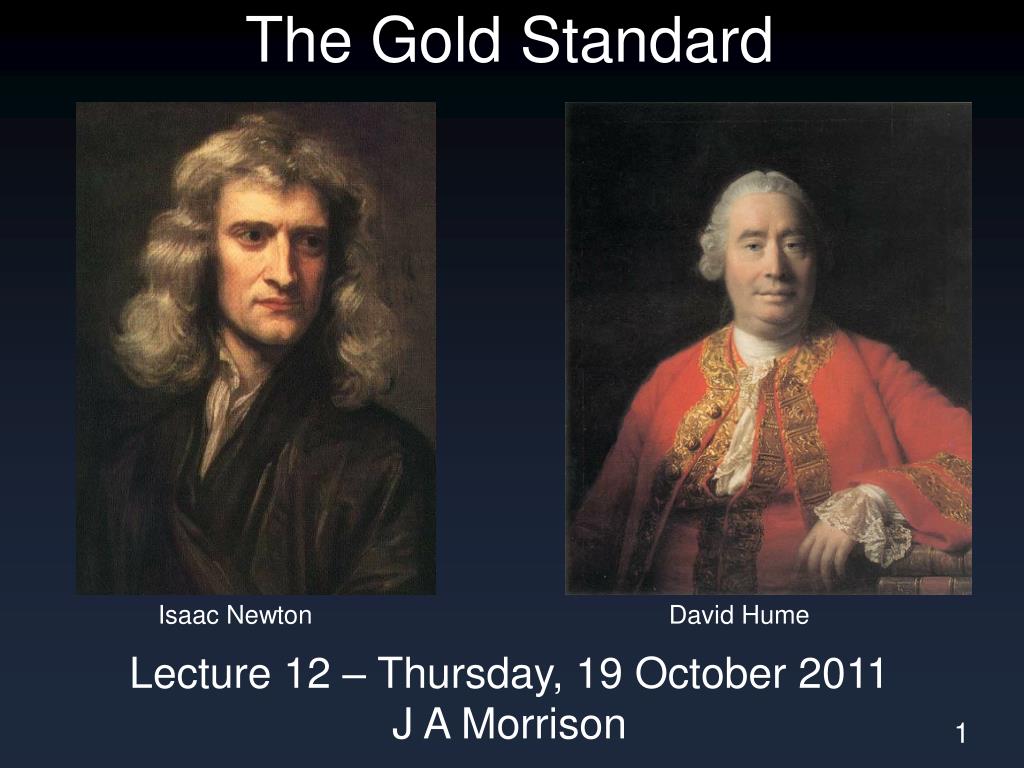
The Gold Standard. Lecture 12 – Thursday, 19 October 2011 J A Morrison. Isaac Newton. David Hume. 1. Lec 12: The Gold Standard. Intro: Why bother with Gold? The Gold Standard as an Ideal Type Breaking the “Rules of the Game” Brief History of the International Gold Standard Conclusion. 3.
Une image / un lien ci-dessous est fourni (tel quel) pour télécharger la présentation
Politique de téléchargement : le contenu du site vous est fourni TEL QUEL pour votre information et votre usage personnel ; il ne peut être vendu, concédé sous licence ni partagé sur d’autres sites sans l’accord de son auteur.Le contenu vous est fourni TEL QUEL, pour votre information et votre usage personnel uniquement.Téléchargez la présentation en cliquant sur ce lien.Lors du téléchargement, si vous ne parvenez pas à télécharger une présentation, l’éditeur a peut-être supprimé le fichier de son serveur.Pendant le téléchargement, si vous ne parvenez pas à obtenir une présentation, le fichier a peut-être été supprimé par l’éditeur.
F I N
Plus de contenu associé
Transcription de la présentation
The Gold Standard Lecture 12 – Thursday, 19 October 2011J A Morrison Isaac Newton David Hume 1
Lec 12: The Gold Standard • Intro: Why bother with Gold? • The Gold Standard as an Ideal Type • Breaking the “Rules of the Game” • Brief History of the International Gold Standard • Conclusion 3
Lec 12: The Gold Standard • Intro: Why bother with Gold? • The Gold Standard as an Ideal Type • Breaking the “Rules of the Game” • Brief History of the International Gold Standard • Conclusion 4
Historical Significance • Provides insight into most of monetary history • Integral to First Era of Globalization • Enduring legacies in contemporary system • International Monetary Fund • Distribution of worldwide gold supply 5
Intellectual Significance • Robust alternative to current system of floating ERs • Lessons from First Era of Globalization • Parallels with current crises • China’s “dirty float” • Constraints and opportunities generated by currency union (e.g. Euro) 6
Lec 12: The Gold Standard • Intro: Why bother with Gold? • The Gold Standard as an Ideal Type • Breaking the “Rules of the Game” • Brief History of the International Gold Standard • Conclusion 7
Purchasing Power Parity (PPP) • Purchasing power (PP): command over goods and services • $919.50 = 1 oz gold • £639.43 = 1 oz gold • PPP: money enjoys the same purchasing power in every market even after making necessary conversions • Implied PPP (based on gold prices): $1 = £0.695 • PPP can be calculated using any “basket” of goods & services • The Economist uses the Big Mac! 20
PPP versus Market Rates • Implied PPP (from gold prices): $1 = £0.695 • If I can trade $1 for £0.695, I should be able to buy gold at the same “price” in GB and in the US • BUT Market Exchange Rate: $1 = £0.691 Why the difference? Why doesn’t arbitrage eliminate the difference? 21
Valuation • Valuation: the relationship between market price and underlying “value” • Different ways to calculate valuation • Stock: price-to-earnings-to-growth (PEG) ratio • Currency: PP versus ER • Over and Under • Overvalued: currency purchases less than ER implies (PP < ER) • Undervalued: currency purchases more than ER implies (PP > ER) 27
GS Regulation of Quantity • Official/Mint Price: price of gold in terms of local currency • Free Conversion: monetary authority should… • Purchase gold with currency at the official price • Sell gold for currency at the official price • Automatic Quantity Adjustment • Overvalued currency sell currency for gold decrease in currency and increase of gold • Undervalued currency sell gold for currency increase in currency and decrease in gold • Sustained increases in gold price mining 30
By regulating the quantity of currency automatically, adherence to the GS would theoretically ensure domestic price stability.After all, if the official ER did not match the PPP, currency/gold would be converted. 31
Rise in US Prices Excess Gold in US US Imports Increase; Exports Decrease US Prices Fall; BoT Equilibrates US Exports Gold GS Regulation of Distribution • David Hume’s Price-Specie-Flow Model • Assume: costless int’l transport & conversion 33
Lec 12: The Gold Standard • Intro: Why bother with Gold? • The Gold Standard as an Ideal Type • Breaking the “Rules of the Game” • Brief History of the International Gold Standard • Conclusion 35
(1) Maintain Exchange Rate Stability (“gold parity”) --> the monetary authority commits to doing everything in its power to ensure that the market ER with gold remains at the predetermined, official “parity.” 12
Reconciling the BoP under the Gold Standard • Adjustment of Reserves • Adjustment of Internal Prices & Incomes • Exchange Rate (ER) Adjustment • Exchange Controls • Capital Controls: Limit convertibility • Commercial Policy 15
Bracketing option 1 (adjusting reserves), states face a difficult choice between:(2) allow price-specie-flow to dictate changes in domestic macroeconomic conditions; (4.2) use commercial policy (tariffs, subsidies, &c.) 40
Exchange Rate Adjustment • Specie: Change quantity of precious metal in coins • Backed currency: Adjustment of official exchange rate • Fixed fiat currency: Shift in “target” market rate 45
Limitations on Convertibility • Restrictions on market exchange, foreign investment, and import/export of currency (e.g. China today) • Government imposed costs on conversion • Fees to convert currency via monetary authority • Restrictions on conversion (e.g. delay at the mint) • Tax on capital movement (e.g. Tobin tax) 46
Sterilized Intervention • Intervention: government maintains stable market ER by selling domestic currency in exchange for foreign currency • Foreign currency is then held in reserve • Sterilization: government counters inflation by buying excess domestic currency with government debt (open market operations) • Sterilized Intervention: intervention + sterilization 49
The result is that the exchange rate remains stable, domestic prices and incomes remain stable, and the government simply amasses foreign reserves.This saves the surplus country from having to adjust today.It also provides reserves for a “rainy day” in the future. 50
The sky is the limit! Inflation countered by sterilization Maintained through intervention Surplus Countries under the Gold Standard • Adjustment of Reserves • Adjustment of Internal Prices & Incomes • Exchange Rate (ER) Adjustment • Exchange Controls • Capital Controls: Limit convertibility • Commercial Policy 51
Lec 12: The Gold Standard • Intro: Why bother with Gold? • The Gold Standard as an Ideal Type • Breaking the “Rules of the Game” • Brief History of the International Gold Standard • Conclusion 54
Connexion au compte
Connectez-vous pour publier votre contenu sur SlideServe.