SlideServe
Menu
Préférences
© SlideServe · v2026

The International Gold Standard

aletha avatar
12 diapositives · 765 Views · Aug 06, 2012

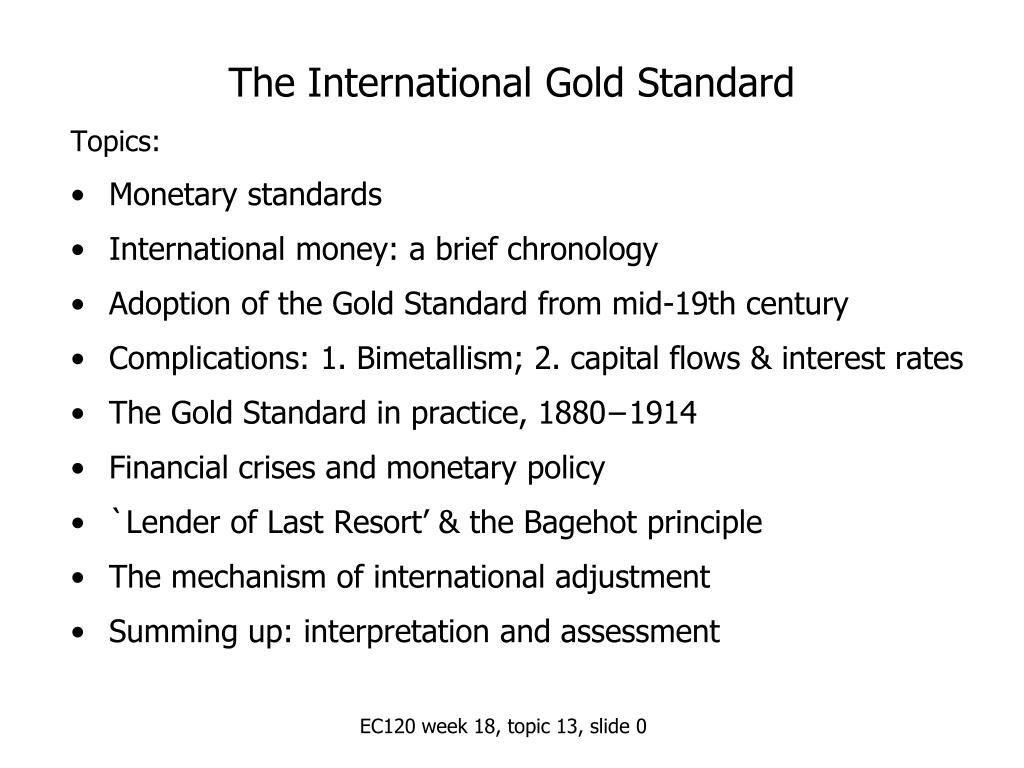
The International Gold Standard. Topics: Monetary standards International money: a brief chronology Adoption of the Gold Standard from mid-19th century Complications: 1. Bimetallism; 2. capital flows & interest rates The Gold Standard in practice, 1880−1914
The International Gold Standard - slide 1
01 / 12The International Gold Standard
1 / 17

Télécharger la présentation

The International Gold Standard
Une image / un lien ci-dessous est fourni (tel quel) pour télécharger la présentation

Politique de téléchargement : le contenu du site vous est fourni TEL QUEL pour votre information et votre usage personnel ; il ne peut être vendu, concédé sous licence ni partagé sur d’autres sites sans l’accord de son auteur.Le contenu vous est fourni TEL QUEL, pour votre information et votre usage personnel uniquement. Téléchargez la présentation en cliquant sur ce lien. Lors du téléchargement, si vous ne parvenez pas à télécharger une présentation, l’éditeur a peut-être supprimé le fichier de son serveur.Pendant le téléchargement, si vous ne parvenez pas à obtenir une présentation, le fichier a peut-être été supprimé par l’éditeur.

F I N

Plus de contenu associé

Transcription de la présentation
  1. The International Gold Standard Topics: • Monetary standards • International money: a brief chronology • Adoption of the Gold Standard from mid-19th century • Complications: 1. Bimetallism; 2. capital flows & interest rates • The Gold Standard in practice, 1880−1914 • Financial crises and monetary policy • `Lender of Last Resort’ & the Bagehot principle • The mechanism of international adjustment • Summing up: interpretation and assessment

  2. Monetary standards • A spectrum of standards between the extremes of: • Adopt another currency altogether • Peg currency to a precious metal (“fixed parity”) • Floating exchange rates with other currencies • Some currencies were pegged to two (or more) metals

  3. International money: a brief chronology • Prior to mid/late 19C: various, based on precious metals • International Gold Standard, c1870−1914 • Interwar period, 1918−39: `Gold Exchange Standard’ • Bretton Woods, 1945−71: Adjustable pegged exch. rates • Since 1971: mixed `system’, mostly quasi-floating

  4. Adoption of the Gold Standard from mid-19C • Move to gold was piecemeal • How the Gold Standard worked, perhaps: • Exports>Imports: inflow of gold • Imports>Exports: outflow of gold • Hume’s `specie flow’ model:exports <> imports  changes in money (gold) stock  goods’ prices  exports = imports  `external balance’

  5. Complications, 1: Bimetallism • What is `bimetallism’? • Currency pegged to two metals, e.g. gold and silver • Often attractive when precious metals are used as money • In practice one metal, gold, became dominant • But the silver lobby did not die easily: “... You shall not press down upon the brow of labor this crown of thorns, you shall not crucify mankind upon a cross of gold.” William Jennings Bryan, 1896

  6. Complications, 2: capital flows & interest rates • Δ(money stock) = (exports − imports) + net capital inflow • Capital flows include borrowing/lending as well as gold • `International Trilemma’: allows only two of − • Fixed exchange rates (e.g. gold standard) • Capital mobility • Independent monetary policy • To uphold the gold standard, (c) was abandoned

  7. The Gold Standard in practice, 1880−1914 • Varieties of `Gold Standard’: • Only a core group issued gold coins (specie standard) • Some countries issued a mixture (inc. token currency) • Many countries held foreign exchange as reserves • Worldwide deflation: c1873 to c1896 declining price levels

  8. Financial Crises & Monetary Policy • More sophisticated finance supported trade and industry– But recurring crises had widespread impact • Expanding international trade links increased the need for stable monetary standards: unsystematic adoption of gold or silver • Twin goals of state monetary policies: • Internal balance: stable price level and prosperity • External balance: to maintain the currency’s convertibility • Inadequate financial supervision of banking systems to achieve policy objectives

  9. The Bagehot Principle • Policy problem: to maintain both internal & external balance • External balance was threatened if gold flowed abroad • Internal balance was threatened if banks fail (or in distress) • Bagehot principles: a lender of last resort that • Lends freely • On good collateral, but • At penal (high) interest rates • Bagehot problem: moral hazard

  10. The mechanism of international adjustment • Very little gold was shipped from one country to another • Were the “rules of the game” obeyed? • Central banks manipulated interest rates • Central banks co-ordinated their policies • In times of `stress’ convertibility was suspended

  11. Stability of the international Gold Standard • Adherence to the Gold Standard: was seen as a • “Good Housekeeping Seal of Approval” • Stability/instability at the periphery: mixed experience • Stability among the core nations seemed robust

  12. Summing up: interpretation and assessment • Why the international gold standard worked: • Kindleberger’s `theory of hegemonic stability’ • Eichengreen emphasises credibility and co-operation • International stability a cause or an effect of the G.S.? • How long could it have survived?