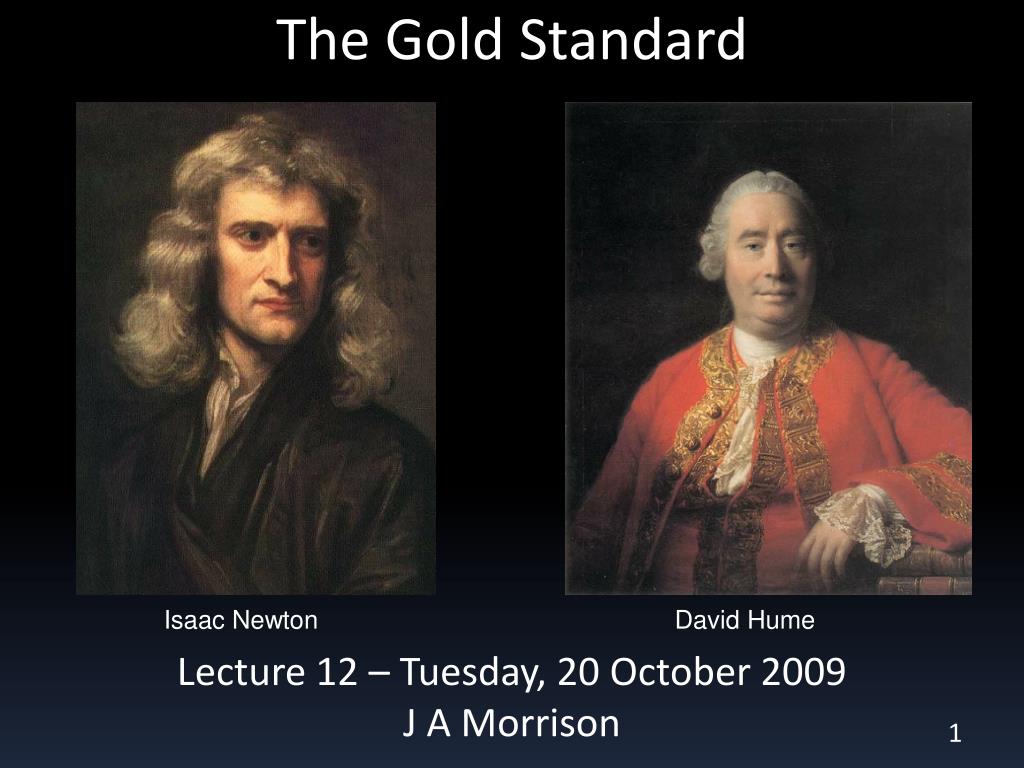
The Gold Standard. Lecture 12 – Tuesday, 20 October 2009 J A Morrison. Isaac Newton. David Hume. Admin. Papers Returned Upcoming Events 7 PM, Tues, 27 Oct: Screening of Niall Ferguson’s The Ascent of Money (2009) Thurs, 29 Oct: Deadline for Second Discussion Post. The Gold Standard.
Une image / un lien ci-dessous est fourni (tel quel) pour télécharger la présentation
Politique de téléchargement : le contenu du site vous est fourni TEL QUEL pour votre information et votre usage personnel ; il ne peut être vendu, concédé sous licence ni partagé sur d’autres sites sans l’accord de son auteur.Le contenu vous est fourni TEL QUEL, pour votre information et votre usage personnel uniquement.Téléchargez la présentation en cliquant sur ce lien.Lors du téléchargement, si vous ne parvenez pas à télécharger une présentation, l’éditeur a peut-être supprimé le fichier de son serveur.Pendant le téléchargement, si vous ne parvenez pas à obtenir une présentation, le fichier a peut-être été supprimé par l’éditeur.
F I N
Plus de contenu associé
Transcription de la présentation
The Gold Standard Lecture 12 – Tuesday, 20 October 2009J A Morrison Isaac Newton David Hume
Admin • Papers Returned • Upcoming Events • 7 PM, Tues, 27 Oct: Screening of Niall Ferguson’s The Ascent of Money (2009) • Thurs, 29 Oct: Deadline for Second Discussion Post
The Gold Standard • Leftovers: Exchange Rates in the Balance of Payments • The “Gold Standard” as an Ideal Type • The Reality of the Gold Standard • Conclusion
The Gold Standard • Leftovers: Exchange Rates in the Balance of Payments • The “Gold Standard” as an Ideal Type • The Reality of the Gold Standard • Conclusion
Last Thursday’s Lecture: Int’l Monetary Exchange in Theory • Introductory: Money is Hard • The Basics of Monetary Exchange • The International Connection • The Nth Currency • Exchange Rate Regimes • The Balance of Payments • Managing the Monetary System Cover this Today Moved to Lecture 14
The Gold Standard • Leftovers: Exchange Rates in the Balance of Payments • The “Gold Standard” as an Ideal Type • The Reality of the Gold Standard • Conclusion
Purchasing Power Parity (PPP) • Purchasing power: command over goods and services • $919.50 = 1 oz gold • £639.43 = 1 oz gold • PPP: unit of currency enjoys the same purchasing power in every market even after making necessary conversions • Implied PPP (based on gold prices): $1 = £0.695 • PPP can be calculated using any “basket” of goods & services • The Economist uses the Big Mac!
PPP versus Market Rates • Implied PPP (from gold prices): $1 = £0.695 • If I can trade $1 for £0.695, I should be able to buy gold at the same “price” in GB and in the US • BUT Market Exchange Rate: $1 = £0.691 • Why the difference? Why doesn’t arbitrage eliminate the difference? • moving and converting currency is not costless!
Valuation • Valuation: the relationship between market price and underlying “value” • Different ways to calculate valuation • Stock: price-to-earnings-to-growth (PEG) ratio • Currency: PPP versus ER • Over and Under • Overvalued: currency purchases less than ER indicates (PPP < ER) • Undervalued: currency purchases more than ER indicates (PPP > ER)
Gresham’s Law • Attributed to Sir Thomas Gresham (1519-1579) • The Law: “Bad money drives out good” • In our terms: “Overvalued currency drives out undervalued currency.” • Implication: don’t attempt to maintain official ER vastly different from market ER This is just a recognition that arbitrage will occur in currency markets, as it does elsewhere.
GS Regulation of Quantity • Official/Mint Price: price of gold in terms of local currency • Free Conversion: monetary authority should… • Purchase gold with currency at the official price • Sell gold for currency at the official price • Automatic Quantity Adjustment • Overvalued currency sell currency for gold decrease in currency and increase of gold • Undervalued currency sell gold for currency increase in currency and decrease in gold • Sustained increases in gold price mining
By regulating the quantity of currency automatically, adherence to the GS would theoretically ensure domestic price stability.After all, if the official ER did not match the PPP, currency/gold would be converted.
GS Regulation of Distribution • David Hume’s Price-Specie-Flow Model • Assume: costless int’l transport & conversion Excess Gold in US Rise in US Prices US Imports Increase; Exports Decrease US Prices Fall; BoT Equilibrates US Exports Gold US has BoP Deficits
The Gold Standard • Leftovers: Exchange Rates in the Balance of Payments • The “Gold Standard” as an Ideal Type • The Reality of the Gold Standard • Conclusion
Remember that we’ve been assuming no conversions costs, that it is costless to move from one currency to another through gold.In the market, however, there are costs to converting currency: transport, risk & insurance, opportunity cost of time.
Politically Imposed Costs • Overt Fees (e.g. seigniorage) • Deliberate delays by monetary authority (Adam Smith on Bank of England) • Exchange for low quality, worn coins • Capital controls (China today)