Understanding Memory Architecture and Control in Computer Systems
This overview explores the essential components of memory architecture and control systems within computing. Key elements include instruction memory, address handling, ALU operations, and condition codes. Instruction memory addresses are pivotal for storing and controlling sequences, while clock cycles dictate operational steps. The architecture incorporates data manipulation through ALU-generated status bits, like carry and overflow, which influence program flow. Practical examples and definitions clarify the memory model's role in efficient data processing.

Understanding Memory Architecture and Control in Computer Systems
E N D
Presentation Transcript
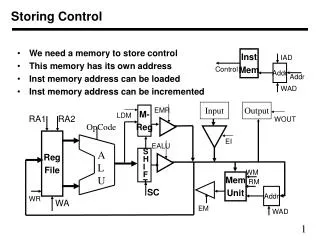
Inst Mem IAD Control Addr Addr WAD RA1 RA2 Input Output M- Reg LDM WOUT OpCode Reg File EMR EALU EI A L U S H I F T WM Mem Unit RM WR SC WA Addr EM WAD Storing Control • We need a memory to store control • This memory has its own address • Inst memory address can be loaded • Inst memory address can be incremented
Inst Mem IAD Control Addr Addr WAD RA1 RA2 Input Output M- Reg LDM WOUT OpCode Reg File EMR EALU EI A L U S H I F T WM Mem Unit RM WR SC WA Addr EM WAD Exercising Control • Control sequences are stored in mmeory • In each clock cycle, one step is executed • Sometime the address needs to be modified • It uses state of the program
Inst Mem IAD Control Addr Addr WAD RA1 RA2 Input Output M- Reg LDM WOUT OpCode Reg File EMR EALU EI A L U S H I F T WM Mem Unit Cond Code RM WR SC WA Addr EM WAD Condition Code • ALU generate status bits like • carry, overflow, sign, and zero • zero=1 means result from ALU is zero • These bits can be used to change flow of program • A new address is generated using CCs